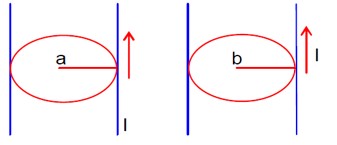
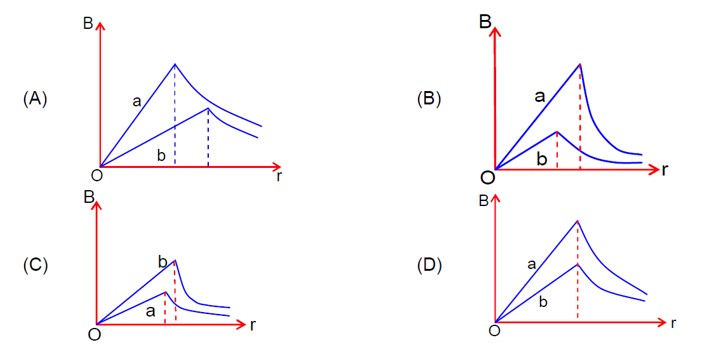
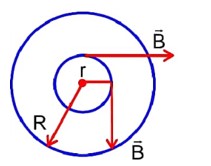
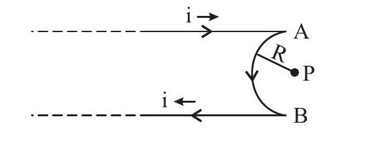
Figure A and B show long straight wires of circular cross section (a and b with a < b), carrying current I which is uniformly distributed across the cross section. The magnitude of magnetic field B varies with radius r and can be represented as:
As b > a The magnetic field inside the wire (rR) is B = µ? I/ (2πr). For wire with radius a, B increases linearly to r=a, then decreases. For wire with radius b, B increases linearly to r=b, then decreases. Since a⇒ B? > B? B? = µ? I / 2πa B? = µ? I / 2πb (Note: The question is likely asking for the graph representation, which is option A based on the formulas.)
<p>As b > a<br>The magnetic field inside the wire (r<R) is B = (µ? Ir)/ (2πR²) and outside (r>R) is B = µ? I/ (2πr).<br>For wire with radius a, B increases linearly to r=a, then decreases. For wire with radius b, B increases linearly to r=b, then decreases. Since a<b, the peak for wire 'a' occurs earlier.<br>⇒ B? > B? <br>B? = µ? I / 2πa<br>B? = µ? I / 2πb<br><em> (Note: The question is likely asking for the graph representation, which is option A based on the formulas.)</em></p>
This website uses Cookies and related technologies for the site to function correctly and securely, improve & personalise your browsing experience, analyse traffic, and support our marketing efforts and serve the Core Purpose. By continuing to browse the site, you agree to Privacy Policy and Cookie Policy.