
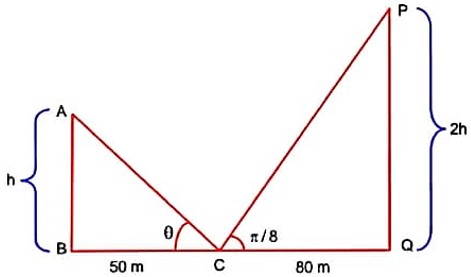
Let AB and PQ be two vertical poles, 160m apart from each other. Let C be the middle points of B and Q, which are feet of these two poles. Let and q be the angles of elevation from C to P and A, respectively. If the height of pole PQ is twice the height of pole AB, then tan2q is equal to
Let AB and PQ be two vertical poles, 160m apart from each other. Let C be the middle points of B and Q, which are feet of these two poles. Let and q be the angles of elevation from C to P and A, respectively. If the height of pole PQ is twice the height of pole AB, then tan2q is equal to
 Upvote
Similar Questions for you
16cos2θ + 25sin2θ + 40sinθ cosθ = 1
16 + 9sin2θ + 20sin 2θ = 1
+ 20sin 2θ = 1
– 9cos 2θ + 40sin 2θ = – 39
48tan2θ + 80tanθ + 30 = 0
24tan2θ + 40tanθ + 15 = 0
&
12x =
is the solution of above equation.
Statement 1 is true
f(0) = – 1 < 0
one root lies in , one root is which is positive. As the coefficients are real, therefore all the roots m
tan2 A = tan B tan C
It is only possible when A = B = C at x = 1
A = 30°, B = 30°, C = 30°
a = sin−1 (sin5) = 5 − 2π
and b = cos−1 (cos5) = 2π − 5
∴ a2 + b2 = (5 − 2π)2 + (2π − 5)2
= 8π2 − 40π + 50
sin 2 + tan 2 > 0
Let tan = x
Taking an Exam? Selecting a College?
Get authentic answers from experts, students and alumni that you won't find anywhere else.
On Shiksha, get access to
Learn more about...

Maths NCERT Exemplar Solutions Class 11th Chapter Seven 2025
View Exam DetailsMost viewed information
SummaryDidn't find the answer you were looking for?
Search from Shiksha's 1 lakh+ Topics
Ask Current Students, Alumni & our Experts
Have a question related to your career & education?
See what others like you are asking & answering