
Particle A of mass m₁ moving with velocity (√3î + ĵ)ms⁻¹ collides with another particle B of mass m₂ which is at rest initially. Let V₁ and V₂ be the velocities of particles A and B after collision respectively. If m₁ = 2m₂ and after collision V₁ = (î + √3ĵ)ms⁻¹, the angle between V₁ and V₂ is:
Particle A of mass m₁ moving with velocity (√3î + ĵ)ms⁻¹ collides with another particle B of mass m₂ which is at rest initially. Let V₁ and V₂ be the velocities of particles A and B after collision respectively. If m₁ = 2m₂ and after collision V₁ = (î + √3ĵ)ms⁻¹, the angle between V₁ and V₂ is:
Option 1 - <p>15°<br><!-- [if !supportLineBreakNewLine]--><br><!--[endif]--></p>
Option 2 - <p>60°</p>
Option 3 - <p>-45°</p>
Option 4 - <p>105°</p>
7 Views|Posted 7 months ago
Asked by Shiksha User
1 Answer
A
Answered by
7 months ago
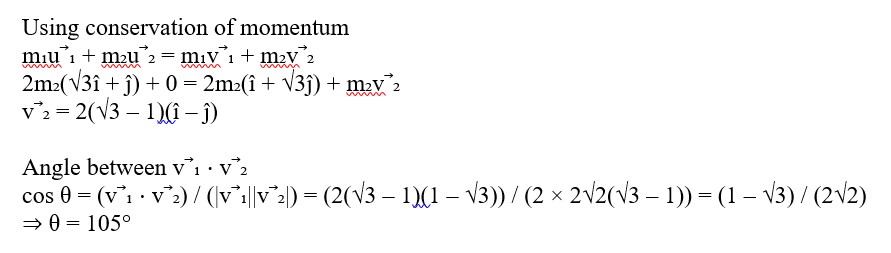
Correct Option - 4
Detailed Solution:
 Upvote
Similar Questions for you

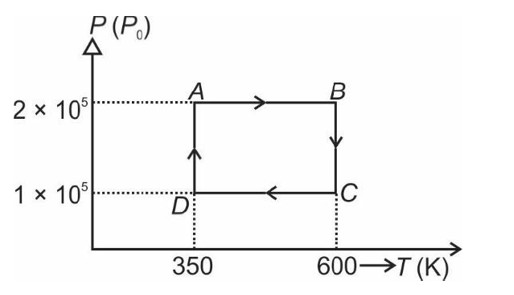
From A to B the process is isobaric
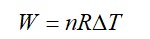
= W = 2 × R (600 - 350)
= 500 R
Taking an Exam? Selecting a College?
Get authentic answers from experts, students and alumni that you won't find anywhere else.
On Shiksha, get access to
66K
Colleges
|
1.2K
Exams
|
6.9L
Reviews
|
1.8M
Answers
Learn more about...

Physics Work, Energy and Power 2021
View Exam DetailsMost viewed information
SummaryDidn't find the answer you were looking for?
Search from Shiksha's 1 lakh+ Topics
or
Ask Current Students, Alumni & our Experts
Have a question related to your career & education?
or
See what others like you are asking & answering