
A point P moves so that the sum of squares of its distances from the points (1, 2) and (2, 1) is 14. Let f(x, y) = 0 be the locus of P, which intersects the x-axis at the points A , B and the y-axis at the points C, D. Then the area of the quadrilateral ACBD is equal to:
A point P moves so that the sum of squares of its distances from the points (1, 2) and (2, 1) is 14. Let f(x, y) = 0 be the locus of P, which intersects the x-axis at the points A , B and the y-axis at the points C, D. Then the area of the quadrilateral ACBD is equal to:
Let point P : (h, k)
Therefore according to question,
locus of P (h, k) is
Now intersection with x – axis are
Now intersection with y – axis are
Therefore are of the quadrilateral ABCD is =
 Upvote
Similar Questions for you
Let A, A’ be (, 2) AB and A’B subtends angle at (0, 0) slope of OA =
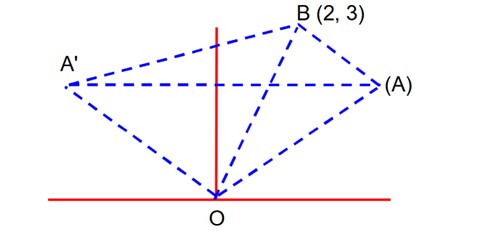
slope of OB =
now distance between A’A, (10, 2) &
Slope of AH = slope of BC =
slope of HC =
slope of BC × slope of HC = -1 p = 3 or 5
hence p = 3 is only possible value.
Let equation of normal to x2 = y at Q (t, t2) is x + 2ty = t + 2t3
It passes through the point (1, -1) so, 2t3 + 3t – 1 = 0
Let f(t) = 2t3 + 3t – 1 f
Let P(1 – sin q, -1 + cos q) slope of normal = slope of CP Þ = tan q according to question ,
Þ g’(t) < 0 Þ g(t) is decreasing function in
Taking an Exam? Selecting a College?
Get authentic answers from experts, students and alumni that you won't find anywhere else.
On Shiksha, get access to
Learn more about...

Maths NCERT Exemplar Solutions Class 12th Chapter One 2025
View Exam DetailsMost viewed information
SummaryDidn't find the answer you were looking for?
Search from Shiksha's 1 lakh+ Topics
Ask Current Students, Alumni & our Experts
Have a question related to your career & education?
See what others like you are asking & answering