
Fill in the blanks for the following (I to xi)
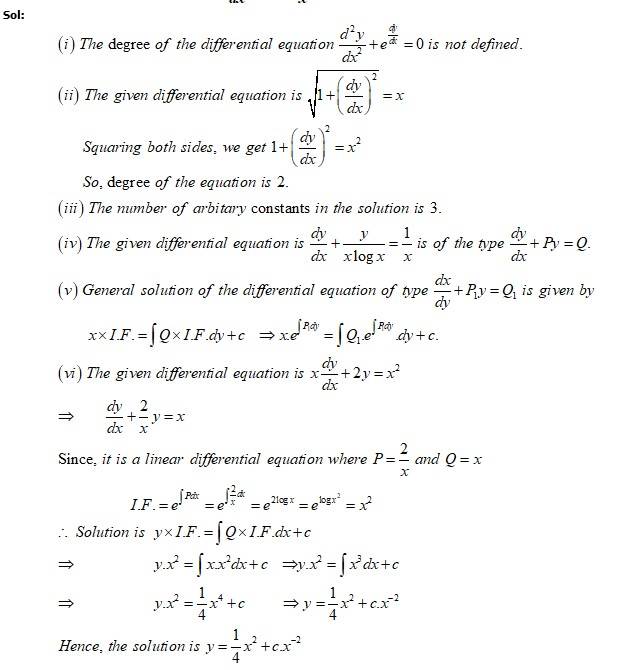
(i) The degree of the differential equation is _________.
(ii) The degree of the differential equation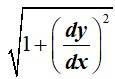 is _________.
(iii) The number of arbitrary constants in the general solution of a differential equation of order three is _________.
(iv) is an equation is of the type _________.
(v) The general solution of a differential equation of the type is given by _________.
(vi) The solution of is _________.
(vii) The solution of is _________.
(viii) The solution of is _________.
(ix) The general solution of is _________.
(x) The solution of is _________.
(xi) The integrating factor of is _________.
Fill in the blanks for the following (I to xi)
(i) The degree of the differential equation is _________.
(ii) The degree of the differential equation is _________.
(iii) The number of arbitrary constants in the general solution of a differential equation of order three is _________.
(iv) is an equation is of the type _________.
(v) The general solution of a differential equation of the type is given by _________.
(vi) The solution of is _________.
(vii) The solution of is _________.
(viii) The solution of is _________.
(ix) The general solution of is _________.
(x) The solution of is _________.
(xi) The integrating factor of is _________.
This is a Fill in the Blanks Type Questions as classified in NCERT Exemplar
 Upvote
Similar Questions for you
It's difficult but in some colleges you may can get
is collinear with
⇒ = …(1)
is collinear with
⇒ …(2)
From (1) and (2)
->
and
, put sin3x + cos3x = t(3 sin2x×cosx – 3cos2xsinx) dx = dt
->
Taking an Exam? Selecting a College?
Get authentic answers from experts, students and alumni that you won't find anywhere else.
On Shiksha, get access to

Didn't find the answer you were looking for?
Search from Shiksha's 1 lakh+ Topics
Ask Current Students, Alumni & our Experts
Have a question related to your career & education?
See what others like you are asking & answering