Find the number of positive integers greater than 6000 and less than 7000 which are divisible by 5, provided that no digit is to be repeated.

5 Views|Posted 7 months ago
Asked by Shiksha User
1 Answer
P
7 months ago

This is a short answer type question as classified in NCERT Exemplar

  A n y n u m b e r d i v i s i b l e b y 5 , i t s u n i t p l a c e m u s t h a v e 0 o r 5 Wehavetofind4-digitnumbergreaterthan6000andlessthan7000. So,theunitplacecanbefilledwith2ways(0or5)since,repetitionisnotallowed. t e n s p l a c e c a n b e f i l l e d w i t h 7 w a y s a n d h u n d r e d s p l a c e c a n b e f i l l e d w i t h 8 w a y s . B u t t h e r e q u i r e d n u m b e r i s g r e a t e r t h a n 6 0 0 0 a n d l e s s t h a n 7 0 0 0 . S o , t h o u s a n d p l a c e c a n b e f i l l e d w i t h 1 d i g i t s i . e . 6 T h 1 H 8 T 7 O 2 So,thetotalnumberofintegers=1*8*7*2=112 Hence,therequirednumberofintegers=112

Thumbs Up IconUpvote Thumbs Down Icon

Similar Questions for you

  | 1 2 2 i + 1 | = α ( 1 2 2 i ) + β ( 1 + i )  

9 4 + 4 = α ( 1 2 2 i ) + β ( 1 + i )

5 2 = α ( 1 2 ) + β + i ( 2 α + β )             

α 2 + β = 5 2      ...(1)

 –2α + β = 0                    …(2)

Solving (1) and (2)

α 2 + 2 α = 5 2

5 2 α = 5 2            

a =

...Read more

Variance = x 2 n ( x ¯ ) 2  

6 0 2 + 6 0 2 + 4 4 2 + 5 8 2 + 6 8 2 + α 2 + β 2 + 5 6 2 8 = ( 5 8 ) 2 = 6 6 . 2            

7 2 0 0 + 1 9 3 6 + 3 3 6 4 + 4 6 2 4 + 3 1 3 6 + α 2 + β 2 8 = 3 3 6 4 = 6 6 . 2             

2 5 3 2 . 5 + α 2 + β 2 8 3 3 6 4 = 6 6 . 2            

α2 + β2 = 897.7 × 8

= 7181.6

...Read more

Start with

(1) E ¯ : 6 ! 2 ! = 3 6 0  

(2)    G E ¯ : 5 ! 2 ! , G N ¯ : 5 ! 2 !  

(3) GTE : 4!, GTN: 4!, GTT : 4!

(4) GTWENTY = 1

360 + 60 + 60 + 24 + 24 + 24 + 1 = 553
...Read more

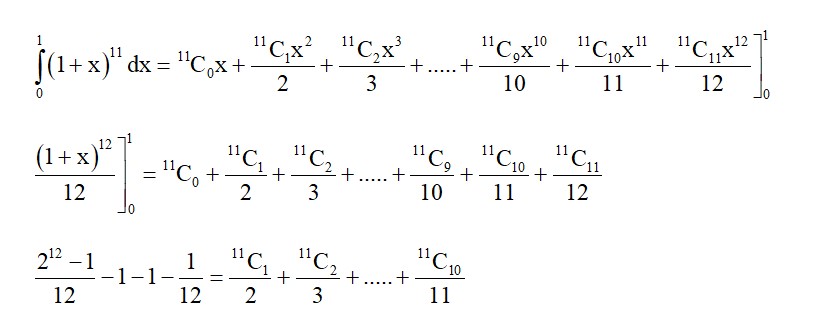
( 1 + x ) 1 1 = 1 1 C 0 + 1 1 C 1 x + 1 1 C 2 x 2 + . . . . . + 1 1 C 1 1 x 1 1

= 2 1 2 2 2 4 1 2
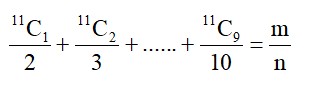
= 2 1 2 2 6 1 2 = 4 0 7 0 1 2 = 2 0 3 5 6 = m n
m + n = 2035 + 6 = 2041


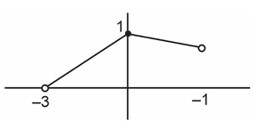
f ( x ) = { 2 + 2 x , x ( 1 , 0 ) 1 x 3 , x [ 0 , 3 )

g ( x ) = { x , x [ 0 , 1 ) x , x ( 3 , 0 )   ->g(x) = |x|, x Î (–3, 1)

f ( g ( x ) ) = { 2 + 2 | x | , | x | ( 1 , 0 ) x ? 1 | x | 3 , | x | [ 0 , 3 ) x ( 3 , 1 )            

f ( g ( x ) ) = { 1 x 3 , x [ 0 , 1 ) 1 + x 3 , x ( 3 , 0 )

Range of fog(x) is [0, 1]


            Range of fog(x) is [0, 1]

...Read more

Taking an Exam? Selecting a College?

Get authentic answers from experts, students and alumni that you won't find anywhere else.

On Shiksha, get access to

66K
Colleges
|
1.2K
Exams
|
6.9L
Reviews
|
1.8M
Answers

Learn more about...

Maths NCERT Exemplar Solutions Class 11th Chapter Seven 2025

Maths NCERT Exemplar Solutions Class 11th Chapter Seven 2025

View Exam Details

Most viewed information

Summary

Share Your College Life Experience

Didn't find the answer you were looking for?

Search from Shiksha's 1 lakh+ Topics

or

Ask Current Students, Alumni & our Experts

Have a question related to your career & education?

or

See what others like you are asking & answering