Let C be a circle passing through the points A(2, 1) and B(3, 4). The line segment AB is not a diameter of C. If r is the radius of C and its centre lies on the circle (x−5)5+(y−1)2=132 , then r2 is equal to

Option 1 - <p>32</p>
Option 2 - <p><span class="mathml" contenteditable="false"> <math> <mrow> <mfrac> <mrow> <mn>6</mn> <mn>5</mn> </mrow> <mrow> <mn>2</mn> </mrow> </mfrac> </mrow> </math> </span></p>
Option 3 - <p><span class="mathml" contenteditable="false"> <math> <mrow> <mfrac> <mrow> <mn>6</mn> <mn>1</mn> </mrow> <mrow> <mn>2</mn> </mrow> </mfrac> </mrow> </math> </span></p>
Option 4 - <p>30</p>
19 Views|Posted a year ago
Asked by Shiksha User
1 Answer
P
a year ago
Correct Option - 2
Detailed Solution:

Equation of perpendicular bisector of AB is

y−32=−15 (x−52)⇒x+5y=10

Solving it with equation of given circle,

(x−5)2+ (10−x5−1)2=132

⇒x−5=±52⇒x=52or  152

But

x≠52

because AB is not the diameter.

So, centre will be

(152, 12)

Now,

r2= (152−2)2+ (12+1)2=652

Thumbs Up IconUpvote Thumbs Down Icon

Similar Questions for you

∫ − π 2 π 2 ( x 2 c o s x 1 + π 2 + 1 + s i n 2 x 1 + e ( s i n x ) 2 0 2 3 ) d x = π 4 ( π + α ) − 2

∫ 0 π 2 { ( x 2 c o s x 1 + π x + 1 + s i n 2 x 1 + e ( s i n x ) 2 0 2 3 ) + ( x 2 c o s x 1 + π − x + 1 + s i n 2 x 1 + e − ( s i n x ) 2 0 2 3 ) } d x

= π 4 ( π + α ) − 2

∫ 0 π 2 ( x 2 c o s x + 1 + s i n 2 x ) d x = π 4 ( π + α ) − 2

∫ 0 π 2 x 2 c o s x d x + ∫ 0 π 2 ( 1 + s i n 2 x ) d x = π 4 ( π + α ) − 2 ....(1)

Let I 1 = ∫ 0 π 2 ( 1 + s i n 2 x ) d x

I 1 = ∫ 0 π 2 1 ⋅ d x + ∫ 0 π 2 ( 1 − c o s 2 x 2 ) d x

I 1 = π 2 + 1 2 [ π 2 + 0 ]

I 1 = 3 π 4

Let I 2 = ∫ 0 π 2 x 2 c o s x d x

I 2 = [ x 2 ( s i n x ) − ∫ 2 x ∫ c o s x d x ] 0 π 2

I 2 = [ x 2 ( s i n x ) − 2 ∫ x s i n x ] 0 π 2

I 2 = [ x 2 s i n x − 2 ( x ( − c o s x ) + ∫ c o s x ) ] 0 π 2

I 2 = [ x 2 s i n x − 2 ( − x c o s x + s i n x ) ] 0 π 2

I 2 = ( π 2 4 − 2 )

Put l1 and l2 in (1)

π 2 4 − 2 + 3 π 4

π 2 4 + 3 π 4 − 2

π 4 ( π + 3 ) − 2

α = 3

Given | a → | = 1 , | b → | = 4 , a → ⋅ b → = 2

c → = 2 ( a → × b → ) − 3 b →  

Dot product with  a → on both sides

c → ⋅ a → = − 6 ... (1)

Dot product with  b →  on both sides

b → ⋅ c → = − 4 8 ... (2)

c → ⋅ c → = 4 | a → × b → | 2 + 9 | b → | 2

| c → | 2 = 4 [ | a → | 2 ⋅ | b → | 2 − ( a → ⋅ b → ) 2 ] + 9 | b → | 2

| c → | 2 = 4 [ ( 1 ) ( 4 ) 2 − ( 4 ) ] + 9 ( 1 6 )

| c → | 2 = 4 [ 1 2 ] + 1 4 4

| c → | 2 = 4 8 + 1 4 4

| c → | 2 = 1 9 2

c o s θ = b → ⋅ c → | b → | | c → |

c o s θ = − 4 8 1 9 2 ⋅ 4

c o s θ = − 4 8 8 3 ⋅ 4

c o s θ = − 3 2 3

c o s θ = − 3 2 θ = c o s − 1 ( − 3 2 )


...Read more

(a – 1) × 2 + (b – 2) × 5 + (g – 3) × 1 = 0

2a + 5b + g – 15 = 0

Also, P lie on line

a + 1 = 2λ

b – 2 = 5λ

g – 4 = λ

2 (2λ – 1) + 5 (5λ + 2) + λ + 4 – 15 = 0

4λ + 25λ + λ – 2 + 10 + 4 – 15 = 0

30λ – 3 = 0

λ = 1 1 0  

a + b + g = (2λ – 1) + (5λ + 2) + (λ + 4)
= 8 λ + 5 = 8 1 0 + 5 = 5 . 8

...Read more

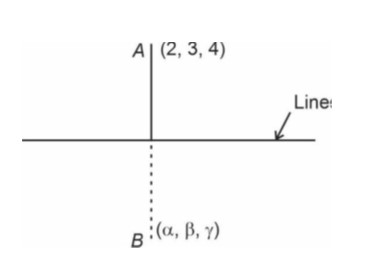
Take x − 1 2 = y − 2 3 = z − 3 4 = λ  

x = 2λ + 1, y = 3λ + 2, z = 4λ + 3

  A B →  = (α − 2)  i ^ + (β − 3) j ^ + (γ − 4) k ^  

Now,

(α − 2) ⋅ 2 + (β − 3) ⋅3 + (γ − 4) ⋅ 4 = 0

2α − 4 + 3β − 9 + 4γ −16 = 0

⇒ 2α + 3β + 4γ = 29

...Read more

L 1 = x − λ 1 = y − 1 2 1 2 = z − 1 2

∴ S D = | − 2 λ + 3 ( 2 λ + 1 2 ) + λ | 1 4 = | 5 λ + 3 2 | 1 4

5 λ + 3 2 = − 7 2 ⇒ 5 λ = − 5 ⇒ λ = − 1

∴ | λ | = 1

Taking an Exam? Selecting a College?

Get authentic answers from experts, students and alumni that you won't find anywhere else.

On Shiksha, get access to

67K
Colleges
|
1.2K
Exams
|
7.2L
Reviews
|
1.9M
Answers

Learn more about...

Maths NCERT Exemplar Solutions Class 12th Chapter Six 2025

Maths NCERT Exemplar Solutions Class 12th Chapter Six 2025

View Exam Details

Most viewed information

Summary

Share Your College Life Experience

Didn't find the answer you were looking for?

Search from Shiksha's 1 lakh+ Topics

or

Ask Current Students, Alumni & our Experts

Have a question related to your career & education?

or

See what others like you are asking & answering