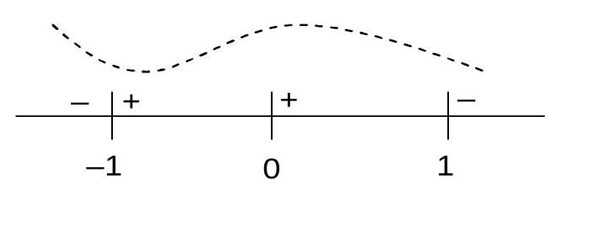
Let f(x) be a polynomial of degree 5 such that x=±1 are its critical points. If l i m x 0 ? 2 + f ( x ) x 3 = 4 , then which one of the following is not true?

Option 1 - <p><span class="mathml" contenteditable="false"> <math> <mi>x</mi> <mo>=</mo> <mn>1</mn> </math> </span>is a point of minima and <span class="mathml" contenteditable="false"> <math> <mi>x</mi> <mo>=</mo> <mo>-</mo> <mn>1</mn> </math> </span> is a point of maxims of <span class="mathml" contenteditable="false"> <math> <mi>f</mi> </math> </span>.</p>
Option 2 - <p><span class="mathml" contenteditable="false"> <math> <mi>x</mi> <mo>=</mo> <mn>1</mn> </math> </span> is a point of maxima and <span class="mathml" contenteditable="false"> <math> <mi>x</mi> <mo>=</mo> <mo>-</mo> <mn>1</mn> </math> </span> is a point of minimum of <span class="mathml" contenteditable="false"> <math> <mi>f</mi> </math> </span>&lt;!--[endif]--&gt;&lt;!--[endif]--&gt;<br>&lt;!-- [if !supportLineBreakNewLine]--&gt;<br>&lt;!--[endif]--&gt;</p>
Option 3 - <p><span class="mathml" contenteditable="false"> <math> <mi>f</mi> </math> </span>is an odd function</p>
Option 4 - <p><span class="mathml" contenteditable="false"> <math> <mi>f</mi> <mo>(</mo> <mn>1</mn> <mo>)</mo> <mo>-</mo> <mn>4</mn> <mi>f</mi> <mo>(</mo> <mo>-</mo> <mn>1</mn> <mo>)</mo> <mo>=</mo> <mn>4</mn> </math> </span><br>&lt;!--[endif]--&gt;&lt;!--[endif]--&gt;</p>
14 Views|Posted 6 months ago
Asked by Shiksha User
1 Answer
A
6 months ago
Correct Option - 2
Detailed Solution:

f ' ( x ) = a ( x + 1 ) ( x - 1 ) x 2

f ' ( x ) = a x 4 - x 2 f

f ( x ) = a x 5 5 - a x 3 5 + C
? f ( 0 ) = 0 c = 0

l i m x 0 ? f ( x ) x 3 = 2

a = - 6

Minima at f ' ( x ) = - 6 x 2 - 1 x 2

Maxima at x = - 1


Thumbs Up IconUpvote Thumbs Down Icon

Similar Questions for you

l i m n k = 1 n n 3 n 4 ( 1 + k 2 n 2 ) ( 1 + 3 k 2 n 2 )

= l i m n 1 n k 1 n 1 ( 1 + k 2 n 2 ) ( 1 + 3 k 2 n 2 )

= 0 1 d x 3 ( 1 + x 2 ) ( 1 3 + x 2 )

= 0 1 1 3 × 3 2 ( x 2 + 1 ) ( x 2 + 1 3 ) ( 1 + x 2 ) ( x 2 + 1 3 ) d x

= 1 2 [ 3 t a n 1 ( 3 x ) ] 0 1 1 2 ( t a n 1 x ) 0 1

= 3 2 ( π 3 ) 1 2 ( π 4 ) = π 2 3 π 8

Lt? →? x/ (1−sinx)¹/? − (1+sinx)¹/? )
= 2x/ (1−sinx)¹/? − (1+sinx)¹/? ) Multiply by conjugate
= 4x/ (1−sinx)¹/²− (1+sinx)¹/²) Multiply by conjugate
= 8x/ (1−sinx−1−sinx) Multiply by conjugate
= 4x/sinx = −4

lim (x→0) [a e? - b cos (x) + c e? ] / (x sin (x) = 2
Using Taylor expansions around x=0:
lim (x→0) [a (1+x+x²/2!+.) - b (1-x²/2!+.) + c (1-x+x²/2!+.)] / (x * x) = 2
lim (x→0) [ (a-b+c) + x (a-c) + x² (a/2+b/2+c/2) + O (x³)] / x² = 2
For the limit to exist, the coefficients of lower powers of x in the n

...Read more

Let t = 3^ (x/2). As x→2, t→3^ (2/2) = 3.
The limit becomes lim (t→3) [ (t² + 27/t²) - 12 ] / [ (t - 3²/t) ].
lim (t→3) [ (t? - 12t² + 27)/t² ] / [ (t² - 9)/t ].
lim (t→3) [ (t²-9) (t²-3) / t² ] * [ t / (t²-9) ].
lim (t→3) [ (t²-3) / t ].
Substituting t=3: (3²-3)/3 = (9-3)/3 = 6.
(The provided solution a

...Read more

P (x) = 0
x² - x - 2 = 0
(x-2) (x+1) = 0
x = 2, -1 ∴ α = 2
Now lim (x→2? ) (√ (1-cos (x²-x-2) / (x-2)
⇒ lim (x→2? ) (√ (2sin² (x²-x-2)/2) / (x-2)
⇒ lim (x→2? ) (√2 sin (x²-x-2)/2) / (x²-x-2)/2) ⋅ (x²-x-2)/2) ⋅ (1/ (x-2)
⇒ for x→2? , (x²-x-2)/2 → 0?
⇒ lim (x→2? ) √2 ⋅ 1 ⋅ (x-2) (x+1)/ (2 (x-2) = 3/√2

Taking an Exam? Selecting a College?

Get authentic answers from experts, students and alumni that you won't find anywhere else.

On Shiksha, get access to

66K
Colleges
|
1.2K
Exams
|
6.9L
Reviews
|
1.8M
Answers

Learn more about...

Maths Ncert Solutions class 11th 2026

Maths Ncert Solutions class 11th 2026

View Exam Details

Most viewed information

Summary

Share Your College Life Experience

Didn't find the answer you were looking for?

Search from Shiksha's 1 lakh+ Topics

or

Ask Current Students, Alumni & our Experts

Have a question related to your career & education?

or

See what others like you are asking & answering