
Let the functions f: R → R and g: R → R be defined as :
f(x) = {x+2, x<0; x², x≥0} and g(x) = {x³, x<1; 3x-2, x≥1}
Then, the number of points in R where (fog)(x) is NOT differentiable is equal to :
Let the functions f: R → R and g: R → R be defined as :
f(x) = {x+2, x<0; x², x≥0} and g(x) = {x³, x<1; 3x-2, x≥1}
Then, the number of points in R where (fog)(x) is NOT differentiable is equal to :
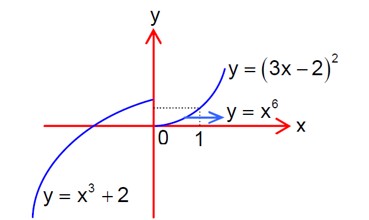
Given f (g (x) is defined piecewise:
f (g (x) =
x³ + 2 ; x < 0
x? ; 0? x < 1
(3x - 2)² ; x? 1
fog (x) is discontinuous at x = 0.? non differentiable.
fog (x) is not differentiable at x = 0.
 Upvote
Similar Questions for you
gof is differentiable at x = 0
So R.H.D = L.H.D.
⇒ 4 = 6 – k1 Þ k1 = 2
Now g (f (-4) + g (f (4)
=2 (2e4 – 1)
cont at x = 1, a + b = 1
diff at x = 1, 2a = 1
Differentiable ⇒ continuous
Continuous at x = 2 ⇒ 2a + b = 0
Continuous at x = 3
0 = 9p + 3q + 1
Differentiable at x=2
a = 2×2 - 5 ⇒ a = -1
Differentiable at x=3
2×3 - 5 = 2p×3 + q ⇒ 6p + q = 1
a = -1, b = 2, p = 4/9, q = -5/3
g (x) = (f (nf (x) – n)?
g' (x) = n (f (nf (x) – n)? ¹ . f' (nf (x) – n) . n . f' (x)
∴ g' (0) = 0
⇒ 4 = n (f (nf (0) – n)? ¹ . f' (nf (0) – n) . nf' (0)
⇒ 4 = n (f (0)? ¹ . f' (0) . nf' (0)
⇒ 4 = n . 1 . (-1) . n (-1)
n² = 4
⇒ n = 2
Taking an Exam? Selecting a College?
Get authentic answers from experts, students and alumni that you won't find anywhere else.
On Shiksha, get access to
Learn more about...

Maths Continuity and Differentiability 2025
View Exam DetailsMost viewed information
SummaryDidn't find the answer you were looking for?
Search from Shiksha's 1 lakh+ Topics
Ask Current Students, Alumni & our Experts
Have a question related to your career & education?
See what others like you are asking & answering