The triangle of maximum area that can be inscribed in a given circle of radius 'r' is:

Option 1 - <p>An isosceles triangle with base equal to 2r.</p>
Option 2 - <p>An equilateral triangle having each of its side of length &lt;!-- [if gte mso 9]>&lt;xml&gt; <o:OLEObject Type="Embed" ProgID="Equation.DSMT4" ShapeID="_x0000_i1025" DrawAspect="Content" ObjectID="_1819616683"> </o:OLEObject> &lt;/xml&gt;&lt;![endif]--&gt;&nbsp;<span class="mathml" contenteditable="false"> <math> <mrow> <mroot> <mrow> <mn>3</mn> </mrow> <mrow></mrow> </mroot> <mi>r</mi> </mrow> </math> </span></p>
Option 3 - <p>A right angle triangle having two of its sides of length 2r and r.</p>
Option 4 - <p>An equilateral triangle of height &lt;!-- [if gte mso 9]>&lt;xml&gt; <o:OLEObject Type="Embed" ProgID="Equation.DSMT4" ShapeID="_x0000_i1025" DrawAspect="Content" ObjectID="_1819616697"> </o:OLEObject> &lt;/xml&gt;&lt;![endif]--&gt;&nbsp;<span class="mathml" contenteditable="false"> <math> <mrow> <mfrac> <mrow> <mn>2</mn> <mi>r</mi> </mrow> <mrow> <mn>3</mn> </mrow> </mfrac> <mo>.</mo> </mrow> </math> </span></p>
2 Views|Posted 4 months ago
Asked by Shiksha User
1 Answer
A
4 months ago
Correct Option - 2
Detailed Solution:

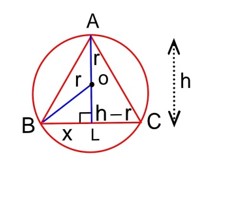
From option let it be isosceles where AB = AC then

x = r 2 ( h r ) 2            

 =   r 2 h 2 r 2 + 2 r h

x = 2 h r h 2 . . . . . . . . ( i )        

Now ar ( Δ A B C ) = Δ = 1 2 B C * A L

Δ = 1 2 * 2 2 h r a 2 * h       

then   x = 2 * 3 r 2 * r 9 r 2 4 = 3 2 r f r o m ( i )

B C = 3 r      

So . A B = h 2 + x 2 = 9 r 2 4 + 3 r 2 4 = 3 r

Hence Δ be equilateral having each side of length 3 r .  
 

Thumbs Up IconUpvote Thumbs Down Icon

Similar Questions for you

It's difficult but in some colleges you may can get 

  a + 5 b  is collinear with c  

  a + 5 b = c           …(1)

b + 6 c is collinear with a  

⇒   b + 6 c = μ a               …(2)

From (1) and (2)

  b + 6 c = μ ( λ c 5 b )          

-> ( 1 + 5 μ ) b + ( 6 λ μ ) c = 0

? b and c

( s i n x c o s x ) s i n 2 x t a n x ( s i n 3 x + c o s 3 x ) d x

( s i n x c o s x ) s i n x c o s x s i n 3 x + c o s 3 x d x , put sin3x + cos3x = t(3 sin2x×cosx – 3cos2xsinx) dx = dt

-> 1 3 d t t

= l n t 3 + c

= l n | s i n 3 x + c o s 3 x | 3 + c


...Read more

f ( x ) = ( 2 x + 2 x ) t a n x t a n 1 ( 2 x 2 3 x + 1 ) ( 7 x 2 3 x + 1 ) 3

f ( x ) = ( 2 x + 2 x ) . t a n x . t a n 1 ( 2 x 2 3 x + 1 ) . ( 7 x 2 3 x + 1 ) 3

f ' ( x ) = ( 2 x + 2 x ) . s e c 2 x . t a n 1 ( 2 x 2 3 x + 1 ) . ( 7 x 2 3 x + 1 ) 3 + t a n x . ( Q ( x ) )

f ' ( 0 ) = 2 . 1 π 4 . 1

= π


Taking an Exam? Selecting a College?

Get authentic answers from experts, students and alumni that you won't find anywhere else.

On Shiksha, get access to

66K
Colleges
|
1.2K
Exams
|
6.9L
Reviews
|
1.8M
Answers

Learn more about...

Maths Inverse Trigonometric Functions 2021

Maths Inverse Trigonometric Functions 2021

View Exam Details

Most viewed information

Summary

Share Your College Life Experience

Didn't find the answer you were looking for?

Search from Shiksha's 1 lakh+ Topics

or

Ask Current Students, Alumni & our Experts

Have a question related to your career & education?

or

See what others like you are asking & answering