12.7 (a) Using the Bohr’s model calculate the speed of the electron in a hydrogen atom in the n = 1, 2, and 3 levels. (b) Calculate the orbital period in each of these levels.

0 19 Views | Posted 7 months ago
Asked by Shiksha User

  • 1 Answer

  • V

    Answered by

    Vishal Baghel | Contributor-Level 10

    7 months ago

    12.7 Let v 1 be the speed of the electron of the hydrogen atom in the ground state level, n 1 = 1 . For charge e of an electron, v 1 is given by the relation

    v 1 = e 2 n 1 4 ? ? 0 ( h 2 ? ) = e 2 2 n 1 ? 0 h

    w h e r e , e = 1.6 * 10 - 19

    ? 0 = Permittivity of free space = 8.85 * 10 - 12 N - 1 C 2 m - 2

    h = Planck's constant = 6.626 Js * 10 - 34

    H e n c e v 1 = e 2 2 n 1 ? 0 h ( 1.6 * 10 - 19 ) 2 2 * 1 * 8.85 * 10 - 12 * 6.626 * 10 - 34 = 2.182 * 10 6 m/s

    For level 2, n 2 = 2 ,

    v 2 = e 2 2 n 2 ? 0 h = ( 1.6 * 10 - 19 ) 2 2 * 2 * 8.85 * 10 - 12 * 6.626 * 10 - 34 = 1.091 * 10 6 m/s

    For level 3, n 3 = 3 ,

    v 3 = e 2 2 n 3 ? 0 h = ( 1.6 * 10 - 19 ) 2 2 * 3 * 8.85 * 10 - 12 * 6.626 * 10 - 34 = 0.727 * 10 6 m/s

    Let be the orbital period of the electron when it is in level . Orbital period is given by the expression

    T 1 = 2 ? r 1 v 1 where r 1 = radius of the orbit = n 1 2 h 2 ? 0 ? m e 2 , where

    m = mass of an electron = 9.1 * 10 - 31 kg

    e = 1.6 * 10 - 19 C

    ? 0 = Permittivity of free space = 8.85 * 10 - 12 N - 1 C 2 m - 2

    h = Planck's constant = 6.626 * 10 - 34 Js

    T 1 = 2 ? v 1 * n 1 2 h 2 ? 0 ? m e 2 = 2 * n 1 2 * h 2 * ? 0 v 1 * m * e 2 = 2 * 1 * ( 6.626 * 10 - 34 ) 2 * 8.85 * 10 - 12 2.182 * 10 6 * 9.1 * 10 - 31 * ( 1.6 * 10 - 19 ) 2 = 7.77 * 10 - 78 5.083 * 10 - 62

    =1.53 * 10 - 16 s

    For level n 2 =2, T 2 = 2 * n 2 2 * h 2 * ? 0 v 2 * m * e 2 = 2 * 4 * ( 6.626 * 10 - 34 ) 2 * 8.85 * 10 - 12 1.091 * 10 6 * 9.1 * 10 - 31 * ( 1.6 * 10 - 19 ) 2 = 3.108 * 10 - 77 2.542 * 10 - 62 =

    ...more

Similar Questions for you

A
alok kumar singh

Kindly go through the solution 


A
alok kumar singh

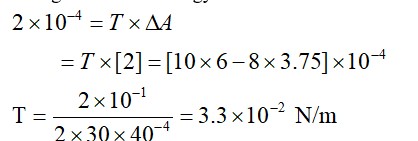
Change in surface energy = work done


A
alok kumar singh

| Δ E 0 | = ( 1 3 6 { 1 1 4 } ) e V

|DE0| = –10.2

λ = 1 2 4 0 0 1 0 . 2 × 1 0 1 0 m

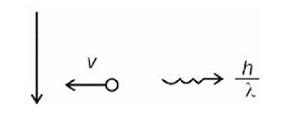
ρ = h λ = 6 . 6 3 × 1 0 3 4 × 1 0 . 2 1 2 4 0 0 × 1 0 1 0                  

? m v = h λ            

  1 . 8 × 1 0 2 7           

v = 6 . 6 3 × 1 0 . 2 × 1 0 3 4 1 2 4 0 0 × 1 0 1 0

v = 6 . 6 3 × 1 0 . 2 1 2 4 0 0 × 1 . 8 × 1 0 3            

= 6 . 6 3 × 1 0 2 1 2 4 × 1 . 8 = 3 . 0 2 ]

= 3 m/s

A
alok kumar singh

0 . 8 5 = 1 3 . 6 n 2  

n = 4

Number of transitions = 4 × 3 2 = 6  

A
alok kumar singh

Kinetic energy: Potential energy = 1 : –2

Get authentic answers from experts, students and alumni that you won't find anywhere else

Sign Up on Shiksha

On Shiksha, get access to

  • 66k Colleges
  • 1.2k Exams
  • 680k Reviews
  • 1800k Answers

Learn more about...

Share Your College Life Experience

Didn't find the answer you were looking for?

Search from Shiksha's 1 lakh+ Topics

or

Ask Current Students, Alumni & our Experts

×
×

This website uses Cookies and related technologies for the site to function correctly and securely, improve & personalise your browsing experience, analyse traffic, and support our marketing efforts and serve the Core Purpose. By continuing to browse the site, you agree to Privacy Policy and Cookie Policy.

Need guidance on career and education? Ask our experts

Characters 0/140

The Answer must contain atleast 20 characters.

Add more details

Characters 0/300

The Answer must contain atleast 20 characters.

Keep it short & simple. Type complete word. Avoid abusive language. Next

Your Question

Edit

Add relevant tags to get quick responses. Cancel Post