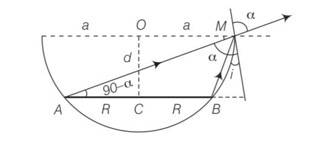
A circular disc of radius R is placed co-axially and horizontally inside an opaque hemispherical bowl of radius a (figure). The far edge of the disc is just visible when viewed from the edge of the bowl. The bowl is filled with transparent liquid of refractive index μ. and the near edge of the disc becomes just visible. How far below the top of the bowl is the disc placed?
This is a short answer type question as classified in NCERT Exemplar
Refering to the figure, AM is the direction of incidence ray before liquid is filled. After liquid is filled in, BM is the direction of the incident ray. Refracted ray in both cases is same as that along AM
A total refractive prism is also known as a total internal reflection prism. It is an optical prism that is designed for reflecting 100% of the incident light. This happens since this prism uses the principle of total internal reflection. These prisms are oriented and shaped in a specific way so tha
Total deviation in a prism is the total angle by which the light ray gets bent as it passes through the prism. It is an angle between incident ray and emergent ray of the prism. When a light enters the prism, it will bend towards the normal. After that, it will travel through the prism and bend away
There are different types of glasses that are used in optical instruments, including the following:
Crown glass (K): This glass is used in eyeglasses, microscopes and cameras. It is used in prisms and windows in optical systems. Crown glass has a low refractive index, low dispersion and excellent tra
Optical instruments can have some of the following defects that may impact their performance, which have arisen due to design limitations, manufacturing and physical properties of light:
Chromatic Aberration: This defect occurs because of the different wavelengths of light that refract at slightly di
Yes, optical instruments are used in modern medicine for many purposes including surgery, monitoring, research and diagnosis. Let us take a look at each one by one:
Many optical instruments are used for visualizing internal structures for diagnosis of a disease and its monitoring. These include Ophth



 Upvote