A spherically symmetric charge distribution is considered with charge density varying

as ρ(r)={ρ0(34rR)forrRzeroforr>R

Where, r(r < R) is the distance from the centre O (as shown in figure). The electric field at point P will be:

Option 1 - <p><span class="mathml" contenteditable="false"> <math> <mrow> <mfrac> <mrow> <msub> <mrow> <mi>ρ</mi> </mrow> <mrow> <mn>0</mn> </mrow> </msub> <mi>r</mi> </mrow> <mrow> <mn>4</mn> <msub> <mrow> <mi>ε</mi> </mrow> <mrow> <mn>0</mn> </mrow> </msub> </mrow> </mfrac> <mrow> <mo>(</mo> <mrow> <mfrac> <mrow> <mn>3</mn> </mrow> <mrow> <mn>4</mn> </mrow> </mfrac> <mo>−</mo> <mfrac> <mrow> <mi>r</mi> </mrow> <mrow> <mi>R</mi> </mrow> </mfrac> </mrow> <mo>)</mo> </mrow> </mrow> </math> </span></p>
Option 2 - <p><span class="mathml" contenteditable="false"> <math> <mrow> <mfrac> <mrow> <msub> <mrow> <mi>ρ</mi> </mrow> <mrow> <mn>0</mn> </mrow> </msub> <mi>r</mi> </mrow> <mrow> <mn>3</mn> <msub> <mrow> <mi>ε</mi> </mrow> <mrow> <mn>0</mn> </mrow> </msub> </mrow> </mfrac> <mrow> <mo>(</mo> <mrow> <mfrac> <mrow> <mn>3</mn> </mrow> <mrow> <mn>4</mn> </mrow> </mfrac> <mo>−</mo> <mfrac> <mrow> <mi>r</mi> </mrow> <mrow> <mi>R</mi> </mrow> </mfrac> </mrow> <mo>)</mo> </mrow> </mrow> </math> </span></p>
Option 3 - <p><span class="mathml" contenteditable="false"> <math> <mrow> <mfrac> <mrow> <msub> <mrow> <mi>ρ</mi> </mrow> <mrow> <mn>0</mn> </mrow> </msub> <mi>r</mi> </mrow> <mrow> <mn>4</mn> <msub> <mrow> <mi>ε</mi> </mrow> <mrow> <mn>0</mn> </mrow> </msub> </mrow> </mfrac> <mrow> <mo>(</mo> <mrow> <mn>1</mn> <mo>−</mo> <mfrac> <mrow> <mi>r</mi> </mrow> <mrow> <mi>R</mi> </mrow> </mfrac> </mrow> <mo>)</mo> </mrow> </mrow> </math> </span></p>
Option 4 - <p><span class="mathml" contenteditable="false"> <math> <mrow> <mfrac> <mrow> <msub> <mrow> <mi>ρ</mi> </mrow> <mrow> <mn>0</mn> </mrow> </msub> <mi>r</mi> </mrow> <mrow> <mn>5</mn> <msub> <mrow> <mi>ε</mi> </mrow> <mrow> <mn>0</mn> </mrow> </msub> </mrow> </mfrac> <mrow> <mo>(</mo> <mrow> <mn>1</mn> <mo>−</mo> <mfrac> <mrow> <mi>r</mi> </mrow> <mrow> <mi>R</mi> </mrow> </mfrac> </mrow> <mo>)</mo> </mrow> </mrow> </math> </span></p>
8 Views|Posted 6 months ago
Asked by Shiksha User
1 Answer
V
6 months ago
Correct Option - 3
Detailed Solution:

 ρr= {ρ0 (34rR)forrR0forr>R

Pr=E4πr2=qencε0

As,  E4πr2=πρ0r3ε0 (1rR)

E=ρ0r4ε0 (1rR)

Thumbs Up IconUpvote Thumbs Down Icon

Similar Questions for you

The following are the topics covered in this chapter: Electric Field and Field Lines, Gauss's Law, Electric Dipole, Conductors and Insulators, and Electric Flux. 

Indeed, it is an easy chapter of Class 12 Physics. In this chapter, you will learn about the foundational concepts like Gauss's law and electric fields.
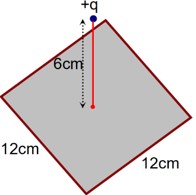
Flux through the 6 sides of square (i.e. cube)

? T = q i n ε 0 = 1 2 × 1 0 6 C ε 0   


Flux through a square

? = ? T 6 = 1 2 × 1 0 6 ε 0 × 6 = 2 × 1 0 6 ε 0

? = 2 2 5 . 9 8 × 1 0 3 N m 2 / C ? 2 2 6 N m 2 / C     

...Read more

In the medical entrance test NEET, this chapter has a moderate weightage. You can expect around 2-3 questions of this chapter that contributes to the 3-5% of the total marks in the Physics section.

From Guass’s Law

? E . d A = q i n 0            

E . 4 π r 2 = 0 r ( 4 π r 2 . d r ) ( α r ) 0            

E = ( α r 2 4 0 )            

...Read more

Taking an Exam? Selecting a College?

Get authentic answers from experts, students and alumni that you won't find anywhere else.

On Shiksha, get access to

66K
Colleges
|
1.2K
Exams
|
6.8L
Reviews
|
1.8M
Answers

Learn more about...

Physics NCERT Exemplar Solutions Class 12th Chapter Nine 2025

Physics NCERT Exemplar Solutions Class 12th Chapter Nine 2025

View Exam Details

Most viewed information

Summary

Share Your College Life Experience

Didn't find the answer you were looking for?

Search from Shiksha's 1 lakh+ Topics

or

Ask Current Students, Alumni & our Experts

Have a question related to your career & education?

or

See what others like you are asking & answering