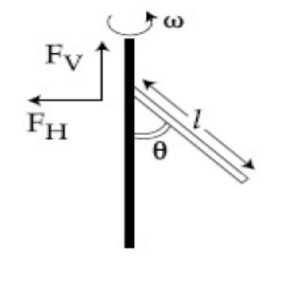
A uniform rod of length 'l' is pivoted at one of its ends on a vertical shaft of negligible radius. When the shaft rotates at angular speed ω  the rod makes an angle   θ with it (see figure). To find θ equate the rate of change of angular momentum (direction going into the paper)   m l 2 12 ω 2 s i n ? θ c o s ? θ about the centre of mass (CM) to the torque provided by the horizontal and vertical forces   F H and   F V about the C M   . The value of θ is then such that:


Option 1 - <p><span class="mathml" contenteditable="false"> <math> <mi mathvariant="normal">c</mi> <mi mathvariant="normal">o</mi> <mi mathvariant="normal">s</mi> <mo>⁡</mo> <mi>θ</mi> <mo>=</mo> <mfrac> <mrow> <mrow> <mi>g</mi> </mrow> </mrow> <mrow> <mrow> <mn>1</mn> <msup> <mrow> <mrow> <mi>ω</mi> </mrow> </mrow> <mrow> <mrow> <mn>2</mn> </mrow> </mrow> </msup> </mrow> </mrow> </mfrac> </math> </span></p>
Option 2 - <p><span class="mathml" contenteditable="false"> <math> <mi mathvariant="normal">c</mi> <mi mathvariant="normal">o</mi> <mi mathvariant="normal">s</mi> <mo>⁡</mo> <mi>θ</mi> <mo>=</mo> <mfrac> <mrow> <mrow> <mn>2</mn> <mi>g</mi> </mrow> </mrow> <mrow> <mrow> <mn>31</mn> <msup> <mrow> <mrow> <mi>ω</mi> </mrow> </mrow> <mrow> <mrow> <mn>2</mn> </mrow> </mrow> </msup> </mrow> </mrow> </mfrac> </math> </span></p>
Option 3 - <p><span class="mathml" contenteditable="false"> <math> <mi mathvariant="normal">c</mi> <mi mathvariant="normal">o</mi> <mi mathvariant="normal">s</mi> <mo>⁡</mo> <mi>θ</mi> <mo>=</mo> <mfrac> <mrow> <mrow> <mn>3</mn> <mi>g</mi> </mrow> </mrow> <mrow> <mrow> <mn>21</mn> <msup> <mrow> <mrow> <mi>ω</mi> </mrow> </mrow> <mrow> <mrow> <mn>2</mn> </mrow> </mrow> </msup> </mrow> </mrow> </mfrac> </math> </span></p>
Option 4 - <p><span class="mathml" contenteditable="false"> <math> <mi mathvariant="normal">c</mi> <mi mathvariant="normal">o</mi> <mi mathvariant="normal">s</mi> <mo>⁡</mo> <mi>θ</mi> <mo>=</mo> <mfrac> <mrow> <mrow> <mi mathvariant="normal">g</mi> </mrow> </mrow> <mrow> <mrow> <mn>2</mn> <mi mathvariant="normal">l</mi> <msup> <mrow> <mrow> <mi>ω</mi> </mrow> </mrow> <mrow> <mrow> <mn>2</mn> </mrow> </mrow> </msup> </mrow> </mrow> </mfrac> </math> </span></p>
18 Views|Posted 5 months ago
Asked by Shiksha User
1 Answer
A
5 months ago
Correct Option - 3
Detailed Solution:

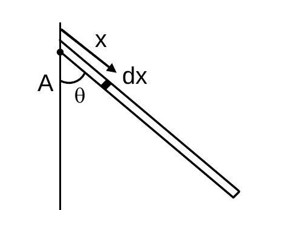
Torque of centrifugal force about A

= d = d m ω 2 ( x s i n ? θ ) ( x c o s ? θ )

= 0 l ? m l d x ω 2 x 2 s i n ? θ c o s ? θ

= m l ω 2 s i n ? θ c o s ? θ x 3 3 0 l = m ω 2 l 2 s i n ? θ c o s ? θ 3

  τ m g = τ centrifugal   (about A)

m g l 2 s i n ? θ = m ω 2 l 2 s i n ? θ c o s ? θ 3

c o s ? θ = 3 g 2 l ω 2


Thumbs Up IconUpvote Thumbs Down Icon

Taking an Exam? Selecting a College?

Get authentic answers from experts, students and alumni that you won't find anywhere else.

On Shiksha, get access to

66K
Colleges
|
1.2K
Exams
|
6.9L
Reviews
|
1.8M
Answers

Learn more about...

Physics System of Particles and Rotational Motion 2025

Physics System of Particles and Rotational Motion 2025

View Exam Details

Most viewed information

Summary

Share Your College Life Experience

Didn't find the answer you were looking for?

Search from Shiksha's 1 lakh+ Topics

or

Ask Current Students, Alumni & our Experts

Have a question related to your career & education?

or

See what others like you are asking & answering