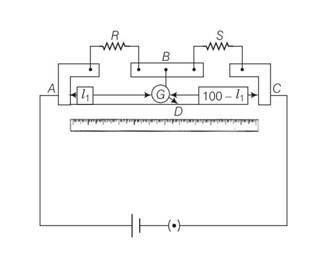
In a meter bridge, the point D is a neutral point (figure). (a) The meter bridge can have no other neutral. A point for this set of resistances. (b) When the jockey contacts a point on meter wire left of D, current flows to B from the wire (c) When the jockey contacts a point on the meter wire to the right of D, current flows from B to the wire through galvanometer (d) When R is increased, the neutral point shifts to left
This is a Multiple Choice Questions as classified in NCERT Exemplar
Answer – (a, c)
Explanation- In case of meter bridge, the resistance wire AC is 100 cm long. Varying the position of tapping point B, bridge is balanced. If in balanced position of bridge AB = l, BC = (100 – l) so that Q/P= (100-l)/l.
According to this chapter, a galvanometer is used to find and measure the small electric currents in a circuit. The principle that works in a galvanometer is the electromagnetic induction.
There are two types of electricity - Static and Current electricity. The electric charges buildup on a material's surface is called the static electricity. The continuous flow of electric charge is termed as the current electricity. Current electricity is of two types - Alternating Current (AC) and
In simple words, current electricity can be defined as the electric charge continuously moving from one place to another along a pathway. It is measured in amperes (A). Electric current is needed for electrical devices to work.
No, in fact, it is one of the easiest chapter of class 12 Physics. Other chapters which are considered comparatively easy are Ray Optics and Electric Charges and Fields.
Taking an Exam? Selecting a College?
Get authentic answers from experts, students and alumni that you won't find anywhere else.
On Shiksha, get access to
67K
Colleges
|
1.2K
Exams
|
7.2L
Reviews
|
1.9M
Answers
Learn more about...
Physics NCERT Exemplar Solutions Class 12th Chapter Three 2025


 Upvote