
In the given circuits (a), (b) and (c), the potential drop across the two p-n junctions are equal in :
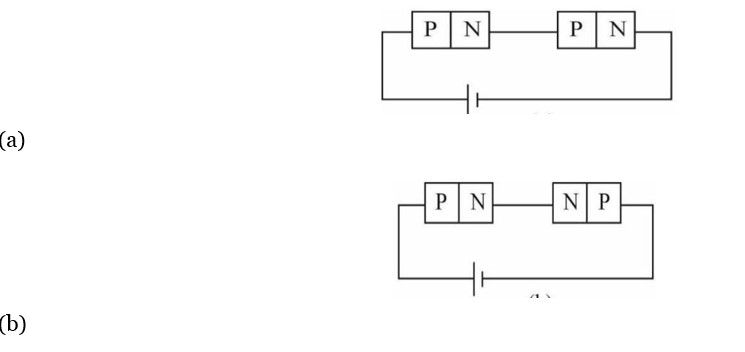
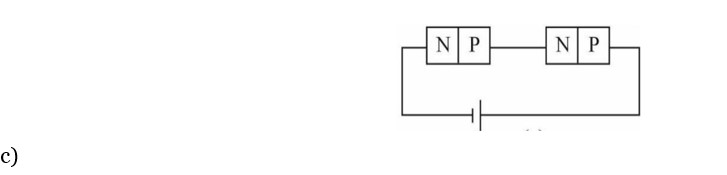
In the given circuits (a), (b) and (c), the potential drop across the two p-n junctions are equal in :
Option 1 - <p>Circuit (a) only<br><!-- [if !supportLineBreakNewLine]--><br><!--[endif]--></p>
Option 2 - <p>Circuit (b) only<br><!-- [if !supportLineBreakNewLine]--><br><!--[endif]--></p>
Option 3 - <p>Circuit (c) only<br><!-- [if !supportLineBreakNewLine]--><br><!--[endif]--></p>
Option 4 - <p>Circuit (a) only (c)</p>
10 Views|Posted a year ago
Asked by Shiksha User
1 Answer
R
Answered by
a year ago
Correct Option - 4
Detailed Solution:
In (a) & (c) circuits, both the junctions are in same biasing conditions so offers equal resistances.
 Upvote
Taking an Exam? Selecting a College?
Get authentic answers from experts, students and alumni that you won't find anywhere else.
On Shiksha, get access to
67K
Colleges
|
1.2K
Exams
|
7.2L
Reviews
|
1.9M
Answers
Learn more about...

Physics Semiconductor Devices 2025
View Exam DetailsMost viewed information
SummaryDidn't find the answer you were looking for?
Search from Shiksha's 1 lakh+ Topics
or
Ask Current Students, Alumni & our Experts
Have a question related to your career & education?
or
See what others like you are asking & answering