
Ask & Answer: India's Largest Education Community

All Questions
New Question
9 months agoContributor-Level 10
Indeed, you can pursue an MSc in MLT or other specialisations like clinical biochemistry, microbiology, or haematology after earning a BSc MLT.
Teaching, R&D, and senior lab positions are better suited for those with an MSc, which also improves job roles and pay scale. Numerous universities directly admit students based on their performance on entrance exams or BSc MLT.
New Question
9 months agoContributor-Level 10
Yes, a diagnostic lab can be opened by a BSc MLT graduate; however, this typically requires State Medical Council registration, the cooperation of a pathologist, and the necessary infrastructure.
Although the degree technically qualifies you, you still need to adhere to government regulations, such as obtaining licenses under Clinical Establishment Acts and NABL accreditation for specific services or tests.
New Question
9 months agoContributor-Level 10
Indeed, BSc MLT is a Paramedical course that teaches students how to use sample analysis and lab-based testing to help diagnose illnesses.
It is regarded as crucial to the operation of diagnostic healthcare services and is included in the field of allied health sciences. In labs, MLT specialists collaborate with physicians to guarantee precise test results.
New Question
9 months agoContributor-Level 10
Yes, you can work as a lab technologist or technician in private clinics, diagnostic labs, or hospitals after earning your BSc in MLT.
New graduates are frequently hired by hospitals to work in sample collection units, pathology labs, or microbiology labs. Employability in clinical settings is further enhanced by gaining some internship experience during the course.
New Question
9 months agoContributor-Level 10
Typically, the BSc MLT programme is divided into three years and six semesters. Additionally, some universities might use an annual system rather than a semester-by-semester one.
Different clinical, technical, and foundational medical topics are covered every semester. The last year or semester of the course also includes hospital internships and hands-on training.
New Question
9 months agoContributor-Level 10
For enrolment in BSc courses at MIT WPU, firstly, candidates should complete the basic eligibility requirements that state applicants must complete their Class 12 with a minimum aggregate of 50% (5% relaxation for reserved categories). Going forward, to get selected, applicants should appear and secure an acceptable scores in MIT-WPU CET (online entrance test).
New Question
9 months agoContributor-Level 10
While still taking a balanced approach, BSc MLT tends to focus more on hands-on training. Students spend a lot of time in diagnostic units, clinical labs, and hospital environments.
Both theoretical study and practical lab work are part of subjects like microbiology, haematology, and histopathology. After graduation, the practical emphasis equips students to function effectively in actual diagnostic settings.
New Question
9 months agoContributor-Level 10
Yes, under their Paramedical course lists, a few AIIMS institutes, including AIIMS Jodhpur, Patna, and Gorakhpur, offer BSc MLT.
The AIIMS Paramedical Entrance Exam is used to admit students to AIIMS MLT courses. Similar laboratory technology paramedical programs are also offered by central universities such as BHU and JIPMER in addition to AIIMS.
New Question
9 months agoContributor-Level 10
No, BSc MLT is not available to students studying the arts or commerce. A background in the Science stream, particularly in 10+2 physics, chemistry, and biology, is strictly required for this course.
Technical courses like microbiology, pathology, and biochemistry that require a foundational understanding of Science are part of the BSc MLT. Alternative healthcare or management courses are available to candidates from non-science streams.
New Question
9 months agoContributor-Level 10
Yes, admission to BSc MLT does not require NEET. In Class 12 or through university-level entrance exams like CUET, IPU CET, etc., the majority of colleges offer admission based on merit.
Paramedical courses like BSc MLT have their own admissions procedures, in contrast to MBBS or BDS. Candidates must, however, fulfil the prerequisites established by the relevant college or university.
New Question
9 months agoContributor-Level 10
Candidates must have taken Physics, Chemistry, and Biology (PCB) in Class 12 in order to apply for a BSc MLT. Additionally, some universities might think about offering mathematics as a fourth elective.
A solid foundation in medical and lab-related concepts is ensured by having a scientific background. A minimum of 50% in PCB subjects from an accredited board is required by the majority of institutions.
New Question
9 months agoContributor-Level 10
Yes, MIT WPU does offer BSc courses for a duration of three years. The university offers distinct specialisations in BSc courses, such as Computer Science, Data Science and Big Data Analytics, Chemistry, etc. To gain admission into these programmes, applicants are required to complete the minimum eligibility requirements and must appear in Mthe IT-WPU CET (online entrance test), followed by a PI.
New Question
9 months ago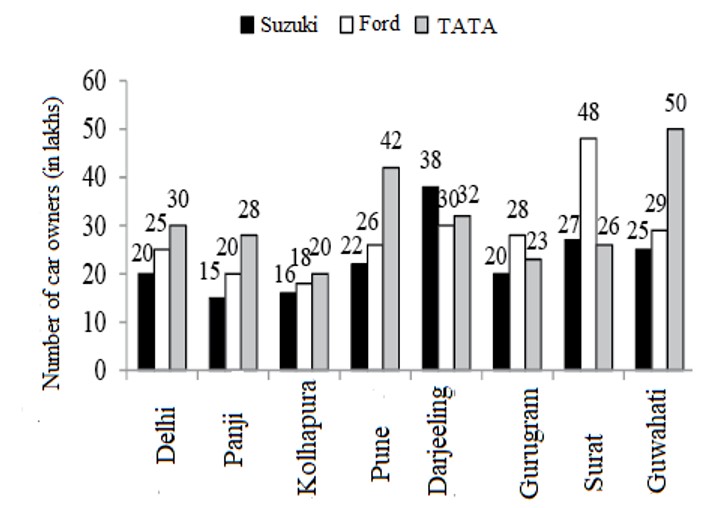
Contributor-Level 10
Total number of car owners of Suzuki, Ford and TATA in the given eight states are 183, 224 and 251 Lacs respectively.
Hence, average number of car owners in the remaining states is:
= 28.292
New Question
9 months agoContributor-Level 10
Yes, MIT-WPU BSc programme includes extensive practical exposure through capstone projects, industry internships, rural outreach, and seminars with top recruiters like Infosys, IBM, Deloitte, and more, ensuring students are industry-ready.
New Question
9 months agoContributor-Level 10
The duration of the BSc courses offered at MIT WPU is three years. Further, these courses are divided into six semesters. In each semester candidates are taught subjects according to their chosen specialisation. The university offers different specialisations in the BSc course, such as Computer Science, Data Science and Big Analytics Data, etc. Moreover, the university also offers one integrated five-year course.
New Question
9 months agoContributor-Level 6
The duration of the UPTET (Uttar Pradesh Teacher Eligibility Test) Paper 1 exam is 150 minutes (2 hours 30 minutes). Candidates who are aspiring to teach Classes 1 to 5 give the UPTET Paper 1 exam. It comprises five sections, namely Child Development and Pedagogy, Language 1 (Hindi), Language 2 (English/Urdu/Sanskrit), Mathematics, and Environmental Studies.
Register to get relevant
Questions & Discussions on your feed
Ask & Answer
Panel of Experts