
Ask & Answer: India's Largest Education Community

All Questions
New Question
10 months agoContributor-Level 10
This is a short answer type question as classified in NCERT Exemplar
Coefficient of
T1= 27+273=300K
Coefficient of performance
1500-5T2=T2
6T2=1500
T2= 250K
T2= 250-273=-23oC
New Question
10 months agoContributor-Level 10
BCom programme at Nazareth College of Arts and Science is a three-year course structured across six semesters. This format offers students a consistent and well-organised academic path, allowing them to gradually deepen their understanding of commerce concepts while preparing for diverse career opportunities in the field.
New Question
10 months agoContributor-Level 10
This is a short answer type question as classified in NCERT Exemplar
Temperature of the source is 270C
T1= 27+273= 300K
T2= -3+273= 270K
Efficiency of heat engine = 1-T2/T1= 1-270/300=1/10
Efficiency of refrigerator is 50% of a perfect engine
= 0.5 = 1/20
Coefficient of performance of the refrigerator
=
Q2= =19W
= 19 1KW=19KW= 19kJ/s
New Question
10 months agoContributor-Level 10
This is a Short Answer Type Questions as classified in NCERT Exemplar
Explanation- relaxation time =mean free path/rms velocity of electron
Also = = relaxation time is inversely proportional to velocities
New Question
10 months agoNew Question
10 months agoContributor-Level 10
This is a short answer type question as classified in NCERT Exemplar
For adiabatic change process we know
P1V1y= P2V2y
P (V+ )y = (P+ )Vy
PVy (1+ ) y=p (1+ )Vy
PVy (1+ ) PVy (1+ )
Y
dV=
hence work done increasing the pressure from P1 to P2
W=
=
W=
New Question
10 months agoContributor-Level 10
This is a Short Answer Type Questions as classified in NCERT Exemplar
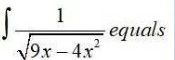
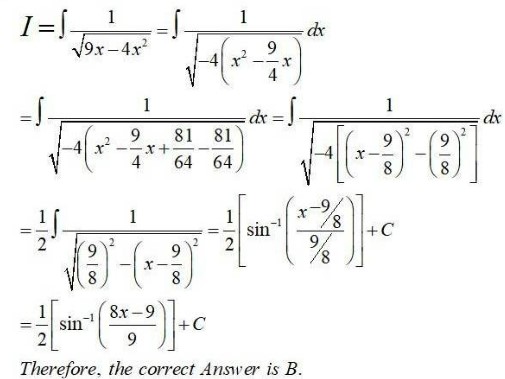
Explanation – In the circuit when an electron approaches a junction, in addition to the uniform E that faces it normally (which keep the drift velocity fixed), as drift velocity (vd) is directly proportional to Electric field (E). That's why there are accumulation of charges on the surface of wires at the junction.
These produce additional electric fields. These fields alter the direction of momentum. Thus, the motion of a charge across junction is not momentum conserving
New Question
10 months agoContributor-Level 10
This is a short answer type question as classified in NCERT Exemplar
Height of stairs h= 10m
Energy produced by burning 1 kg of fat = 7000Kcal
Energy produced by burning 5kg of fat = 5
Energy utilised in going up and down one time
= mgh + =
=
= 9000J= 9000/4.2=3000/1.4cal
Number of times, the person has to go up and down the stairs
= = 16.3 times
New Question
10 months agoNew Question
10 months ago
Contributor-Level 10
This is a Long Answer Type Questions as classified in NCERT Exemplar
Explanation- applying kirchhoff's junction rule I1 = I+I2
Applying kirchhoff's rule in outer loop containing 10V cell
10= IR+10I1……………. (1)
Applying kirchhoff's rule in outer loop containing 2V cell
2= 5I2-RI= 5 (I1-I)-RI
4= 10I1-10I-RI………… (2)
From 1 and 2
6=3RI+10I
2=I (R+10/3)
V= I (R+Reff)
After comparing V=2V, Reff= 10/3 ohm
Since effective internal resistance Reff of two cells 10/3 ohm, being the parallel combination 5 ohm and 10 ohm . the equivalent circuit is
New Question
10 months agoContributor-Level 10
This is a short answer type question as classified in NCERT Exemplar
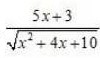
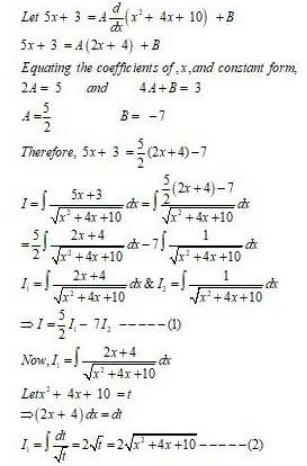
Temperature of the source T1= 500K and sink T2= 300K
Work done W= 1000J
Efficiency of Carnot engine = 1-T2/T1= 1-300/500= 200/500= 2/5
Efficiency = W/Q1
So Q1= W/efficiency = 1000
New Question
10 months agoContributor-Level 9
An international undergraduate must have proof of at least 18 months of full-time, for credit academic study, and graduate applicant must hold a bachelor's degree from a recognised university or equivalent. Along with fulfilling eligibility, students must submit the required documents as requested by the university during admission. The UWM admission requirements for undergraduate and graduate applicants are given below:
UG Requirements:
- Transcripts and degree certificates
- ACT/SAT (optional)
- English language requirements
PG Requirements:
- Transcripts for all university/college attended
- GRE/GMAT (program specific)
- Letter of recommendation
- Portfol
New Question
10 months agoContributor-Level 10
This is a short answer type question as classified in NCERT Exemplar
During driving temperature of the gas increases while volume remains constant. So according charle's law, at constant volume V.
Pressure is directly proportional to temperature. Therefore pressure of gas increases.
New Question
10 months agoContributor-Level 10
This is a Long Answer Type Questions as classified in NCERT Exemplar
Explanation- according to ohm's law V= IR
I= 6/6 = 1A
I= AneVd or Vd= i/neA

New Question
10 months agoContributor-Level 9
University of Wisconsin-Milwaukee usually accepts applications in Spring and Fall intakes for international students. The application usually begins at the end of the year or mid of the year. Students can refer to the table below for the UWM application deadline months:
Particulars | Spring | Fall |
|---|---|---|
UG | Dec starting | Aug starting |
PG | Dec mid | Jul mid |
New Question
10 months agoContributor-Level 10
This is a short answer type question as classified in NCERT Exemplar
Yes during adiabatic compression the temperature of a gas increases while no heat is
In adiabatic compression dQ=0
From the first law of thermodynamics dU= dQ-dW
dU=-dW
in compression work is done on the gas i.e work done is negative
dU=positive
hence internal energy of the gas increases due to which its temperature increases.
Register to get relevant
Questions & Discussions on your feed
Ask & Answer
Panel of Experts