
Ask & Answer: India's Largest Education Community

All Questions
New Question
11 months agoContributor-Level 10
8.30
| Lanthanoids | Actinoids |
Electronic Configuration | It is represented by [Xe]4fx5dy6s2, where x varies from 0 to 14 and y= 0 or 1 | It is represented by [Rn]5fx6dy7s2, where x varies from 0 to 14 and y= 0 or 1. |
Oxidation state | Generally shows +3 oxidation state only in some cases it is +2 or +4 but never greater than +4 | It has +3 oxidation state but also shows higher oxidation states such as +4, +5, +6, +7. |
Atomic and ionic sizes | Ionic radii of M3+ions decrease in size with increase in atomic number this is called as lanthanoid contraction. | There is a gradual decrease in the size of M3+ ions across the series, this is known as actinoid contraction. |
Chemical Reactivity | Lanthanoids are less reactive in nature and form oxides, sulphides, nitrides etc. They have a lesser tendency to form complexes. | They are highly reactive in nature when they are in the finely divided state. They have a higher tendency to form complexes and even react with non-metals at moderate temperature. |
Actinoid Contraction > Lanthanoid contraction
Lanthanoids show lanthanoid contraction due to which their size is quite small as compared to actinoids although there is actinoid contraction also lanthanoid contraction has more impact on elements as there is one shell less than actinoids, so lanthanoids have less tendency to lose an electron and to undergo any reaction like the formation of oxide etc.
New Question
11 months agoContributor-Level 10
The Kerala Plus one admission 2025 fee is given below.
| Category | Fee |
|---|---|
| General/ Open category | INR 25/-. |
| Reserved Category/SC/ST/OBC etc. | INR 10/-. |
New Question
11 months agoContributor-Level 10
8.29 It can be observed from the above table that in the starting of 3d transition series elements like Sc, Ti, V, Cr in +2 state are not that stable in their elements in the +3 state.
In the middle Mn2+, Fe2+, Co2+are quite known. In fact, Mn2+ and Mn7+ are most stable states in Mn. Fe2+ is less stable when compared to Fe3+ which is due to fact that Fe3+ is able to loose one electron to acquire d5 state which has extra stability. Co2+ is less stable as compared to Co3+.
Ni2+ is the most common and stable among its +2, +3, +4 states. Cu2+ is more stable and is quite common as compared to Cu+. Towards the end, Zn forms only Zn2+ whic
New Question
11 months agoContributor-Level 10
In the first semester of the MSc programme at Nagaland University – Kohima Campus, students focus on core foundational subjects. The curriculum includes Geomorphology and Remote Sensing, Structural Geology and Geodynamics, Palaeontology, and Mineralogy. These subjects provide a strong academic foundation and essential skills required for more specialised geological topics in the later semesters.
New Question
11 months agoContributor-Level 10
8.28 Metal ions which have valence electrons in d-orbital and in which d-d transition can take place will be coloured and the metal ions which have completely filled orbital or have d- orbital will be colourless as no d-d transition is possible in those configurations.
Element | Atomic Number | Ionic State | Electronic configuration in ionic state |
Ti | 22 | Ti3+ | [Ar] 3d1 |
V | 23 | V3+ | [Ar] 3d2 |
Cu | 29 | Cu+ | [Ar] 3d10 |
Sc | 21 | Sc3+ | [Ar] |
Mn | 25 | Mn2+ | [Ar] 3d5 |
Fe | 26 | Fe3+ | [Ar] 3d5 |
Co | 27 | Co2+ | [Ar] 3d7 |
From the above table, it can be observed that only Sc3+ and Cu+ have either completely filled d- orbital or empty d-orbital. So, all other ions except Sc3+ and Cu+ will be coloured in aqueous solution because of absorption of radiations which fall in the visible region as on obtaining energy electrons jump from one d-orbital to another.
New Question
11 months agoNew Question
11 months agoContributor-Level 10
8.27 (i) Reduction potential tells us the ease with which the Metal can get reduced, As E° for Cr3+/Cr2+ is negative (–0.4 V), this means that Cr3+ ions in solution cannot be reduced to Cr2+ ions i.e., Cr3+ ions are very stable. As a further comparison of E° values show that Mn3+ ions more readily than Fe3+ ions which means that Mn3+ is least stable.
So Stability of metal ions is as follows:
Mn3+
(ii) Reduction potential tells us the ease with which the Metal can get reduced or the difficulty with which they are oxidized, As the reduction potential increases in the following order Mn2+/Mn < Cr2+/Cr< Fe2+/Fe
So oxidation of Fe is not as easy
New Question
11 months agoContributor-Level 10
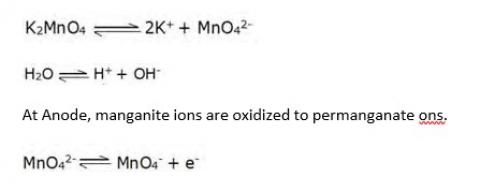
8.26 Potassium permanganate can be prepared from MnO2. It can be done by fusing the ore with KOH in presence of an oxidizing agent like atmospheric oxygen/KNO3 etc to give green coloured K2MnO4 as the product.
2MnO2 + 4KOH + O2 → 2K2MnO4 + 2H2O
The Product K2MnO4 is extracted with water and then oxidised by passing ozone/chlorine into the solution or electrolytically.
Electrolytic oxidation:
(i) Acidified KMnO4 solution oxidizes Fe(II) ions to Fe(III) ions and water as product
MnO4 - + 8H+ + 5e- → Mn2+ + 4H2O
Fe2+→ Fe3++ e- } x5
Overall: MnO4 - + 8H+ + 5Fe2+ → Mn2+ + 4H2O + 5Fe3+
(ii) Acidified potassium permanganate oxidiz
New Question
11 months agoNew Question
11 months agoContributor-Level 10
The Kerala plus one trial allotment was conducted on May 24, 2025.
- Visit the official website of HSCAP at hscap.kerala.gov.in.
- Click on HSCAP Kerala Plus One trial allotment list link available on the home page.
- A new page will be opened.
- Enter the login details.
- Click on submit.
- Allotment details will be displayed.
New Question
11 months agoContributor-Level 10
8.25 K2Cr2O7 acts as a very strong oxidizing agent in acidic medium. K2Cr2O7 gets reduced and acts as an oxidizing agent by oxidizing Iodide to iodine
(i) K2Cr2O7 oxidizes iodide to iodine
Cr2O72-+ 14H++ 6e-→ 2Cr3+ + 7H2O
2I-→ I2 + 2e- } x3
Overall: Cr2O72-+ 14H++ 6I-→ 2Cr3+ + 7H2O+ 3I2
(ii) K2Cr2O7 oxidizes iron(II) to iron(III)
Cr2O72-+ 14H++ 6e-→ 2Cr3+ + 7H2O
Fe2+→ Fe3+ + e- } x6
Overall: Cr2O72-+ 14H++ 6Fe2+→ 2Cr3+ + 7H2O + 6Fe3+
(iii) K2Cr2O7 oxidized H2S to sulphur
Cr2O72-+ 14H++ 6e-→ 2Cr3+ + 7H2O
H2S → S + 2H+ + 2e-} x3
Overall: Cr2O72-+ 8H++ 3H2S → 2Cr3+ + 7H2O +3S
New Question
11 months agoContributor-Level 10
8.24 Potassium dichromate is prepared from chromite ore (FeCr2O4) by the following steps:
Step1: Preparation of sodium dichromate in the reaction of Chromite ore with sodium hydroxide and oxygen gas.
4FeCr2O4 + 16NaOH + 7O2? 8Na2CrO4 + 2Fe2O3 + 8H2O
Step2: Conversion of Sodium Chromate on reaction with concentrated Sulfuric acid gives Sodium dichromate as a product.
2Na2CrO4 + conc. H2SO4? Na2Cr2O7 + Na2SO4 + H2O
Step3: Sodium dichromate on reaction with potassium chloride converts to potassium dichromate as a product.
Na2Cr2O7 + 2KCl? K2Cr2O7 + 2NaCl
As potassium dichromate is less soluble than sodium chloride so, potassium dichromate
New Question
11 months agoContributor-Level 10
The Kerala Plus one trial allotment will be conducted on May 24, 2025. The first allotment will be published on June 2, second allotment on June 10, and the third allotment on June 16, 2025.
New Question
11 months agoContributor-Level 10
8.23 In transition metals, it can be observed that the oxidation state of the metal varies from +1 to +7 which is obtained by removing all its valence electrons. In transition elements the oxidation state differ by 1 unlike non transition elements whose oxidation state differs by 2, for example in transition metals (Cu2+, Cu3+ and Fe2+, Fe3+) and In non-transition elements, this variation is selective, always differing by 2, e.g. S exhibits +2, +4, +6 oxidation states and N exhibits +3, + 5, etc.

New Question
11 months agoContributor-Level 10
For UG Diploma course admission, candidates must meet the eligibility criteria set by CII Institute of Hospitality - Taj Hotels, Chandigarh. Aspirants should pass Class 12 with 50% aggregate. The admission criteria for the course is entrance-based. Students must have cleared Class 12 from a recognised board in India with minimum 50% aggeragte. Added to that, candidate must pass class 12 with English as a subject.
New Question
11 months agoContributor-Level 10
8.22 Interstitial compounds are those compounds in which small atomic size elements like H, C, N occupy the interstitial sites of the crystal lattice of the Transition metal due to their large size.
Example, in the diagram given below:

Here, Green Balls form the Crystal lattice of transition metal and Blue balls represent elements like H/C/N which occupy the interstitial sites.
New Question
11 months agoContributor-Level 10
Kerala Plus one allotment 2025 will be done on June 2, second allotment on June 10, and the third allotment on June 16, 2025. Check the steps below.
- Visit the official website of HSCAP at hscap.kerala.gov.in.
- Click on HSCAP Kerala Plus One first allotment list link available on the home page.
- A new page will open where candidates will have to enter the login details.
- Click on submit and check the allotment details.
New Question
11 months agoContributor-Level 10
8.21 (i) Transition metals and many of their compounds show paramagnetic behavior- Paramagnetic behaviour is shown by transition metals as paramagnetism is due to the presence of unpaired electrons which have a magnetic moment associated with its spin and angular momentum, as the orbital angular momentum is satisfied in the first transition series. So the paramagnetic is only due to the unpaired electrons.
(ii) The enthalpies of atomisation of the transition metals are high- Enthalpies of atomization is the enthalpy change when 1 mol of gaseous atoms is formed from its element in its defined physical state under standard cond

New Question
11 months agoContributor-Level 10
8.20 +3 oxidation state is the most common oxidation state of lanthanides i.e., Ln (III) compounds are predominant. +2 and +4 oxidation states can also be found in the solution or in solid compounds, but are not predominant.
New Question
11 months agoContributor-Level 10
CII Institute of Hospitality - Taj Hotels, Chandigarh offers three Diploma courses in the field of Hospitality Management. The duration of these courses is 18 months. Listed below are the CII Institute of Hospitality - Taj Hotels, Chandigarh courses specialisations:
- Swiss International Culinary Professional Diploma
- Swiss International Food & Beverage Service Professional Diploma
- Swiss International Rooms Professional Diploma
Register to get relevant
Questions & Discussions on your feed
Ask & Answer
Panel of Experts