
Ask & Answer: India's Largest Education Community

All Questions
New Question
11 months agoContributor-Level 10
Mass of the Earth, M = 6.0 kg
Radius of the Earth, R = 6400 km = 6.4 m
Height of geostationary satellite from the surface of the Earth, h = 36000 km = 3.6 m
Gravitational potential energy due to Earth's gravity at height h:
=
= = = 9.44 J/kg
New Question
11 months agoContributor-Level 10
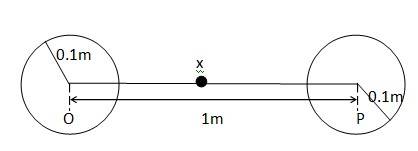
Mass of each sphere, M = 100 kg
Separation between the spheres, r = 1 m
X is the midpoint between the spheres.
Gravitational force at point x will be zero. This is because gravitational force exerted by each spheres will act in opposite directions.
Gravitational potential at point x:
= = 4 = = J/kg
Any object placed at point x will be in equilibrium state, but the equilibrium is unstable. This is because any change in the position of the object will change the effective force in that direction.
New Question
11 months agoContributor-Level 10
ASBM University has not yet released the placement statistics specifically applying to BTech. However, interested candidates can refer to the student reviews posted on the web to find out the highest package offered to BTech students at ASBM University. As per the latest review posted by a BTech student on Shiksha.com, the highest salary package at ASBMU is INR 10 LPA. The student gave a five-star rating (out of five) to BTech placements at ASBMU.
New Question
11 months agoContributor-Level 10
Mass of each star, M = 2 * 1030 kg, Radius of each star, R = 104 km = m
Distance between stars, r = km = m
For negligible speed, v = 0
The total energy of two stars separated at a distance r
= = …….(i)
Now, consider the case when the stars are about to collide. Velocity of the stars = V, distance between the centres of the stars = 2R
Total kinetic energy of both stars = M + M = M
Total potential energy of both stars =
Total energy of two stars = M …….(ii)
Using the law of conservation of energy, we can write
M =
New Question
11 months agoContributor-Level 10
Mass of the Earth, M = 6.0 * 1024 kg
Mass of the satellite, m = 200 kg
Radius of the Earth, = 6.4 *106 m
Universal gravitational constant, G = 6.67 * 10–11 N m2 kg–2
Height of the satellite, h = 400 km = 0.4 m
Total energy of the satellite at height h = + ( )
Orbital velocity of the satellite, v =
Total energy of the satellite at height h = ( - ( ) =
The negative sign indicates that the satellite is bound to the Earth. This is called bound energy of the satellite
Energy require to send the satellite out of its orbit = - (bound energy) =
=&nb
New Question
11 months agoContributor-Level 10
Escape velocity of the projectile on the Earth's surface, = 11.2 km/s = 11.2 m/s
Projection velocity of the projectile = 3
Mass of the projectile = m
Velocity of the projectile far away from the Earth =
Total energy of the projectile on the Earth = m m
Gravitational potential energy of the projectile far away from the Earth is zero.
Total energy of the projectile far away from the Earth = m
From the law of conservation of energy
m m = m
= = = 11.2= 31.68 km/s
New Question
11 months agoContributor-Level 7
For BBA at Thapar (School of Management), the total fee is roughly ₹8–9 Lacs for the full programme (can vary a bit by year).
The average package so far is around ₹6–7 LPA, with top roles going higher as the school's placements mature.
It's a growing program, but Thapar's brand + campus exposure definitely helps.
New Question
11 months agoContributor-Level 10
PhD in Public Policy courses offer many benefits to the students who complete them. Some of the most important advantages are:
Understanding Governance: PhD in Public Policy courses shed light on the operation of governments, decision-making, and policy implementation. Students who have completed PhD in Public Policy courses can use this knowledge in many job fields. It will also help them develop a personal perspective on governmental actions.
Social Impact: Policy making is one of the fastest, most efficient ways to create a change in society. Laws can only be enforced if they have been carefully evaluated and analyzed. Students who wi
New Question
11 months agoContributor-Level 10
Velocity of the rocket, v = 5 km/s = 5 m/s
Mass of the Earth, = 6.0 * 1024 kg
Radius of the Earth, = 6.4 * 106 m
Height reached by rocket mass, m = h
At the Earth's surface
Total energy of the rocket = Kinetic energy + Potential energy = m + ( )
At highest point h, v = 0, and potential energy =
Total energy of the rocket at height h =
From the law of conservation of energy, we have,
Total energy of the rocket at Earth surface = Total energy at height h
m + ( ) = or =
= = = =
New Question
11 months agoContributor-Level 7
While most universities in Nepal do not clear submission of IELTS score, Indian students are advised to take up exam to meet English language requirements. Listed below are the minimum score requirements:
University | English Proficiency Score |
|---|---|
| Kathmandu Medical College | 6.5 or higher |
| Manipal College of Medical Science | 6.5 or higher |
| College of Medical Sciences | 6.0 or higher (with no less than 5.5 in each band) |
| Tribhuvan University | Accepted |
| BP Koirala Institute of Health Sciences | |
| Kathmandu University of Medical Sciences | |
| Patan Academy of Health Sciences |
New Question
11 months agoContributor-Level 10
Weight of a body of mass m at Earth's surface, W = mg = 250 N
Body of mass m is located at depth, d = , where is radius of the Earth
Acceleration due to gravity at depth g (d) is given by : g' = (1 - )g = (1/2)g
Weight of the body at depth d
W' = mg' = (1/2) mg = (1/2)W = (1/2) x 250 N = 125 N
New Question
11 months agoContributor-Level 9
Yes, MIT offers a wide range of courses and is particularly known for the Engineering courses at this university. This university is focused on attracting the best brains of the world to innovate in the world of Engineering.
Below are the postgraduate and undergraduate courses available at this university:
- BSc Science in Engineering
- Biomedical Engineering
- BSc in Chemical Engineering
- BSc in Chemical and Biological Engineering
- BSc in Engineering
- MS in Aeronautics and Astronautics
- D. or Sc. D. in Aeronautics and Astronautics
- PhD in Biomedical Engineering
- MS in Chemical Engineering Practice
- D. in Chemical Engineering
- D. in Chemical Enginee
New Question
11 months agoContributor-Level 10
The tuition fee for the BBA programme at NPU Jharkhand is approximately INR 26,250. This fee may include tuition and other components like security deposit or miscellaneous charges. Additional costs for hostel, mess, and materials may apply. Students should confirm fee details from the official university source during admission.
New Question
11 months agoContributor-Level 10
Weight of the body, W = 63 N
Acceleration due to gravity at h from the Earth's surface is given by
g' = where g = acceleration due to gravity on the Earth's surface, = Radius of the Earth. h =
g' = = = (4/9)g
Weight of the body of mass m at a height h is given by
W' = m X g' = (4/9) mg = (4/9) x w = (4/9) x 63 N = 28 N
New Question
11 months agoContributor-Level 9
JIET Group of Institutions does not take its own entrance exam but accepts national-level exams such as JEE Main, CAT, and GATE. Difficulty varies with the exam you sit for. If you prepare well as per the exam's syllabus, your chances are strong. Mock tests and last year's question papers are useful.
New Question
11 months agoContributor-Level 8
Indian students must meet admission requirements mentioned below for MBBS in Nepal-
- A medical fitness certificate from a registered clinic or hospital.
- A minimum of 50 - 60% aggregate marks in the above-mentioned subjects;
- Senior Secondary Higher Education with Physics, Chemistry, and Biology;
- NEET-UG entrance exam qualification;
- Must be at least 17 years of age before December end of the admission year; and
- Valid passport with at least 18 months of validity
Note: Some universities may require the Medical Education Commission Entrance Examination (MECEE) in addition to NEET.
New Question
11 months agoContributor-Level 10
Yes, admission to the BBA course at NPU Jharkhand is generally merit-based, determined by the candidate's performance in their Class 12 board exams. As of now, no entrance exam is required, making it possible to secure direct admission if minimum eligibility conditions are met.
New Question
11 months agoContributor-Level 10
Distance of the Earth from the Sun, = 1.50 × 10⁸ km = 1.5 × 10¹¹ m
Time period of the Earth = , Time period of the Saturn =
Distance of Saturn from the Sun =
From Kepler’s 3rd law of planetary motion, we have T =(
For Saturn and Sun, we can write, =
= = 1.5 × 1011 = 1.4 X m
New Question
11 months agoContributor-Level 9
JIET Group of Institutions itself doesn't hold an entrance test but takes national and state-level tests. JEE Main, CAT, MAT, XAT, ATMA, GATE, and REAP are taken for admission. Admission is based on performance in these tests followed by counselling. For certain courses such as BDes, admission is on merit basis.
New Question
11 months agoContributor-Level 10
To be eligible for the BBA course at NPU Jharkhand, candidates must have passed Class 12 from CBSE or any recognised board with a minimum required percentage. While the specific cutoff may vary, students must also fulfill all other criteria set by the university at the time of admission.
Register to get relevant
Questions & Discussions on your feed
Ask & Answer
Panel of Experts