
A car is moving in a circular horizontal track of radius 10 with a constant speed of 10 . A bob is suspended from the roof of the car by a light wire of length 1.0 . The angle made by the wire with the vertical is
A car is moving in a circular horizontal track of radius 10 with a constant speed of 10 . A bob is suspended from the roof of the car by a light wire of length 1.0 . The angle made by the wire with the vertical is
Let 
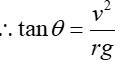
Here, . 
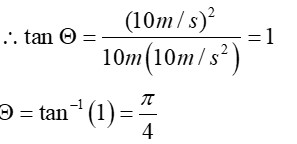
 Upvote
Similar Questions for you
From the physics perspective, in uniform circular motion, speed and angular velocity are constant. That makes the angular acceleration and tangential acceleration are zero. Non-uniform motion, on the other hand, has varying speed and angular velocity, where angular acceleration is non-zero.
The period T is the time taken to complete one full revolution (2? radians). In uniform circular motion, it relates to angular velocity by? =2? /T and to tangential speed by v=? r=2? r/T .
The principle of circular motion follows Newtonian mechanics. It can be stated that an object will move in a circle only when there is a centripetal force that continuously acts perpendicular to its tangential velocity. That changes the direction but not its speed. The inward acceleration a_c = v sq
Circular motion has the following characteristics.
- Fixed radius with the same and constant distance from the centre
- Constant speed, when the motion is uniform
- A changing velocity vector with continuous direction of change
- Centripetal acceleration that is directed radially inwards, while the force that c
By N L M : T sin θ = - (1)
& R = sin θ - (2)
From (1) & (2)
And,
Taking an Exam? Selecting a College?
Get authentic answers from experts, students and alumni that you won't find anywhere else.
On Shiksha, get access to
Learn more about...

Didn't find the answer you were looking for?
Search from Shiksha's 1 lakh+ Topics
Ask Current Students, Alumni & our Experts
Have a question related to your career & education?
See what others like you are asking & answering