
A particle moving in the xy plane experiences a velocity dependent force F = k(vᵧî + vₓĵ), where vₓ and vᵧ are the x and y components of its velocity v. If a is the acceleration of the particle, then which of the following statements is true for the particle?
A particle moving in the xy plane experiences a velocity dependent force F = k(vᵧî + vₓĵ), where vₓ and vᵧ are the x and y components of its velocity v. If a is the acceleration of the particle, then which of the following statements is true for the particle?
Option 1 - <p>quantity v × a is constant in time<br><!-- [if !supportLineBreakNewLine]--><br><!--[endif]--></p>
Option 2 - <p>F arises due to a magnetic field.<br><!-- [if !supportLineBreakNewLine]--><br><!--[endif]--></p>
Option 3 - <p>kinetic energy of particle is constant in time.</p>
Option 4 - <p>quantity v · a is constant in time.</p>
19 Views|Posted 7 months ago
Asked by Shiksha User
1 Answer
A
Answered by
7 months ago
Correct Option - 1
Detailed Solution:
mdv? /dt = kv? (1) and mdv? /dt = kv?
(2)/ (1) ⇒ dv? /dv? = v? /v?
v? dv? = v? dv?
v? ² = v? ² + C
v? ² – v? ² = C = Constant
Now, v? * a? = (v? î + v? ) * (k/m) (v? î + v? )
= (k/m) [v? ²k? – v? ²k? ] = (k/m) (v? ² – v? ²)k? = Constant.
 Upvote
Similar Questions for you
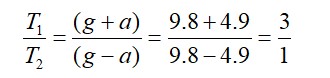
T1 = m (g + a)
T2 = m (g - a)
Apparent weight = mg – ma
Taking an Exam? Selecting a College?
Get authentic answers from experts, students and alumni that you won't find anywhere else.
On Shiksha, get access to
66K
Colleges
|
1.2K
Exams
|
6.9L
Reviews
|
1.8M
Answers
Learn more about...

Didn't find the answer you were looking for?
Search from Shiksha's 1 lakh+ Topics
or
Ask Current Students, Alumni & our Experts
Have a question related to your career & education?
or
See what others like you are asking & answering