
A dolphin decelerates from to in to join another dolphin in play. What average force was exerted to slow the first dolphin if it was moving horizontally? (Assume that gravitational force is balanced by the buoyant force of the water)
A dolphin decelerates from to in to join another dolphin in play. What average force was exerted to slow the first dolphin if it was moving horizontally? (Assume that gravitational force is balanced by the buoyant force of the water)
Option 1 - <p><span class="mathml" contenteditable="false"> <math> <mn>120</mn> <mi> </mi> <mi>N</mi> </math> </span></p>
Option 2 - <p><span class="mathml" contenteditable="false"> <math> <mn>18</mn> <mi> </mi> <mi>N</mi> </math> </span></p>
Option 3 - <p><span class="mathml" contenteditable="false"> <math> <mn>180</mn> <mi> </mi> <mi>N</mi> </math> </span></p>
Option 4 - <p><span class="mathml" contenteditable="false"> <math> <mn>60</mn> <mi> </mi> <mi>N</mi> </math> </span></p>
8 Views|Posted 6 months ago
Asked by Shiksha User
1 Answer
A
Answered by
6 months ago
Correct Option - 3
Detailed Solution:
From equation of uniformly accelerated motion
 Upvote
Similar Questions for you
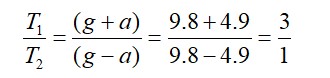
T1 = m (g + a)
T2 = m (g - a)
Apparent weight = mg – ma
Taking an Exam? Selecting a College?
Get authentic answers from experts, students and alumni that you won't find anywhere else.
On Shiksha, get access to
66K
Colleges
|
1.2K
Exams
|
6.9L
Reviews
|
1.9M
Answers
Learn more about...

Didn't find the answer you were looking for?
Search from Shiksha's 1 lakh+ Topics
or
Ask Current Students, Alumni & our Experts
Have a question related to your career & education?
or
See what others like you are asking & answering