
An inverted cone is rotating about its vertical axis. A particle is kept on the inner surface of cone and it is at rest relative to the cone at a height of 0.4 m above its vertex. The coefficient of friction between the surface of cone and the particle is 0.6 and the apex angle of cone is 90°. The maximum angular velocity of revolution of the cone can be: (take g = 10/s2)
An inverted cone is rotating about its vertical axis. A particle is kept on the inner surface of cone and it is at rest relative to the cone at a height of 0.4 m above its vertex. The coefficient of friction between the surface of cone and the particle is 0.6 and the apex angle of cone is 90°. The maximum angular velocity of revolution of the cone can be: (take g = 10/s2)
N = (mg/√2) + (mω²h/√2)
(mω²h/√2) = (mg/√2) + f?
(mω²h/√2) = (mg/√2) + μ (mg/√2) + (mω²h/√2)
ω = √ (g/h) (1+μ)/ (1-μ) = 10rad/s
 Upvote
Similar Questions for you
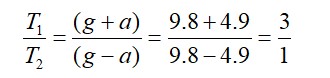
T1 = m (g + a)
T2 = m (g - a)
Apparent weight = mg – ma
Taking an Exam? Selecting a College?
Get authentic answers from experts, students and alumni that you won't find anywhere else.
On Shiksha, get access to
Learn more about...

Didn't find the answer you were looking for?
Search from Shiksha's 1 lakh+ Topics
Ask Current Students, Alumni & our Experts
Have a question related to your career & education?
See what others like you are asking & answering