
Two blocks (m = 0.5kg and M = 4.5kg) are arranged on a horizontal frictionless table as shown in figure. The coefficient of static friction between the two blocks is 3/7. Then the maximum horizontal force that can be applied on the block so that blocks move together is ---------N. (Round off to the Nearest Integer) [ Take g as 9.8 ms-2]
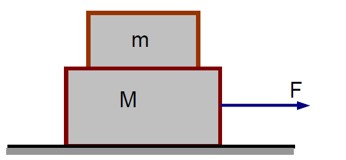
Two blocks (m = 0.5kg and M = 4.5kg) are arranged on a horizontal frictionless table as shown in figure. The coefficient of static friction between the two blocks is 3/7. Then the maximum horizontal force that can be applied on the block so that blocks move together is ---------N. (Round off to the Nearest Integer) [ Take g as 9.8 ms-2]
For the combined system of mass M and m, the acceleration under an applied force F is:
a = F / (M + m)
The static friction force (f_s) on the top block (m) provides its acceleration:
f_s = MA = m * [F / (M + m)] = mF / (M + m)
For the top block not to slip, the required static friction must be less than
 Upvote
Similar Questions for you
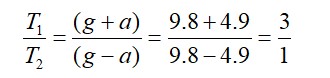
T1 = m (g + a)
T2 = m (g - a)
Apparent weight = mg – ma
Taking an Exam? Selecting a College?
Get authentic answers from experts, students and alumni that you won't find anywhere else.
On Shiksha, get access to
Learn more about...

Didn't find the answer you were looking for?
Search from Shiksha's 1 lakh+ Topics
Ask Current Students, Alumni & our Experts
Have a question related to your career & education?
See what others like you are asking & answering