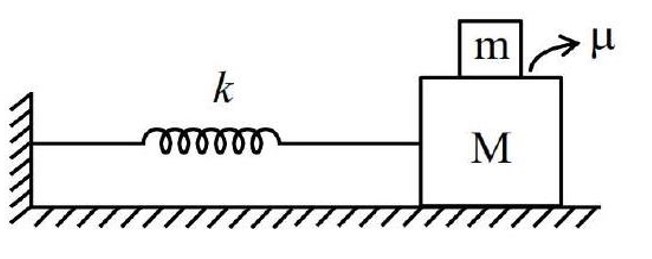
Two blocks of masses m and M, (M > m), are placed on a frictionless table as shown in figure. A massless spring with spring constant k is attached with the lower block. If the system is slightly displaced and released then (μ = coefficient of friction between the two blocks)
(A) The time period of small oscillation of the two blocks is T = 2π √((m+M)/k) (B) The acceleration of the blocks is a = kx/(M+m) (x = displacement of the blocks from the mean position) (C) The magnitude of the frictional force on the upper block is (mμ|x|)/(M+m) (D) The maximum amplitude of the upper block, if it does not slip, is μ(M+m)g/k (E) Maximum frictional force can be μ(M + m)g.
Choose the correct answer from the options given below :
Option 1 -<p>A, B, D Only<br><!-- [if !supportLineBreakNewLine]--><br><!--[endif]--></p>
Option 2 -<p>B, C, D Only</p>
Option 3 -<p>C, D, E Only<br><!-- [if !supportLineBreakNewLine]--><br><!--[endif]--></p>