
Match List - I with List - II:
List - I (Process)
(a) Deacon's process
(b) Contact process
(c) Cracking of hydrocarbons
(d) Hydrogenation of vegetable oils
List - II (Catalyst)
(i) ZSM-5
(ii) CuCl?
(iii) Particles 'Ni'
(iv) V?O?
Choose the most appropriate answer from the options given below
Match List - I with List - II:
List - I (Process)
(a) Deacon's process
(b) Contact process
(c) Cracking of hydrocarbons
(d) Hydrogenation of vegetable oils
List - II (Catalyst)
(i) ZSM-5
(ii) CuCl?
(iii) Particles 'Ni'
(iv) V?O?
Choose the most appropriate answer from the options given below
Matching Processes with Catalysts:
o (a) Deacon's process: CuCl? used as catalyst
o (b) Contact process: V? O? used as catalyst
o (c) Cracking of hydrocarbon: ZSM-5 used as catalyst
o (d) Hydrogenation of vegetable oil: Particles Ni used as catalyst
 Upvote
Similar Questions for you
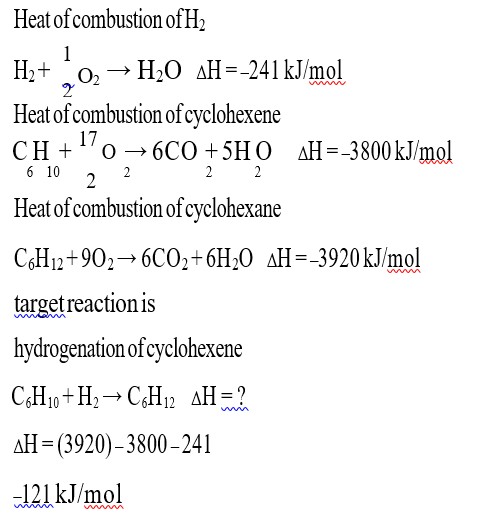
CH3COOH + NaOH → CH3COONa + H2O
ΔH = –50.6 kJ/mol
NaOH + SA [HCl] → NaCl + H2O
ΔH = –55.9 kJ/mol
the value of ΔH for ionisation of CH3COOH
⇒ ΔH = +55.9 – 50.6
5.3 kJ/mol
Kindly consider the solution
Fact.
Kindly go through the solution
Taking an Exam? Selecting a College?
Get authentic answers from experts, students and alumni that you won't find anywhere else.
On Shiksha, get access to
Learn more about...

Chemistry Chemical Equilibrium 2025
View Exam DetailsMost viewed information
SummaryDidn't find the answer you were looking for?
Search from Shiksha's 1 lakh+ Topics
Ask Current Students, Alumni & our Experts
Have a question related to your career & education?
See what others like you are asking & answering