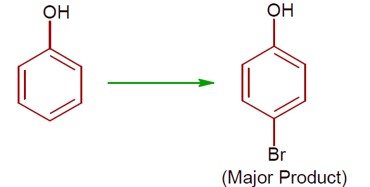
The given reaction can occur in the presence of: (a) Bromine water (b) Br? in CS?, 273 K (c) Br? / FeBr? (d) Br? in CHCl?, 273 K Choose the correct answer from the options given below:
Option 1 -<p>(a) and (c) only<br><!-- [if !supportLineBreakNewLine]--><br><!--[endif]--></p>
Option 2 -<p>(b), (c) and (d) only<br><!--[endif]--></p>
Option 3 -<p>(b) and (d) only<br><!-- [if !supportLineBreakNewLine]--><br><!--[endif]--></p>
(a) Phenol with Br? / H? O gives 2,4,6-tribromophenol. (High ionisation due to polar solvent and high activation of ring) (b) Phenol with Br? in CS? /CHCl? /FeBr? gives a mixture of o- and p-bromophenol, with p-bromophenol as the major product. (less ionisation due to non- polar solvent) [Chemical

 Upvote