
66. Suppose that two cards are drawn at random from a deck of cards. Let X be the number of aces obtained. What is the value of E(X)?
(A)
(B)
(C)
(D)
66. Suppose that two cards are drawn at random from a deck of cards. Let X be the number of aces obtained. What is the value of E(X)?
(A)
(B)
(C)
(D)
66. Let X denote the number of aces obtained. Therefore, X can take any of the values of 0, 1, or 2.
In a deck of 52 cards, 4 cards are aces. Therefore, there are 48 non-ace cards.

X | 0 | 1 | 2 |
P (X) | 1128/1326 | 192/1326 | 6/1326 |
Therefore, option D is correct
 Upvote
Similar Questions for you
P (2 obtained on even numbered toss) = k (let)
P (2) =
P (
If x = 0, y = 6, 7, 8, 9, 10
If x = 1, y = 7, 8, 9, 10
If x = 2, y = 8, 9, 10
If x = 3, y = 9, 10
If x = 4, y = 10
If x = 5, y = no possible value
Total possible ways = (5 + 4 + 3 + 2 + 1) * 2
= 30
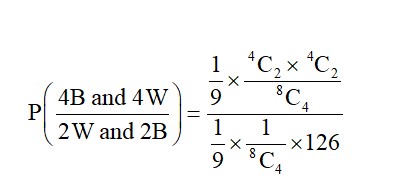
Required probability
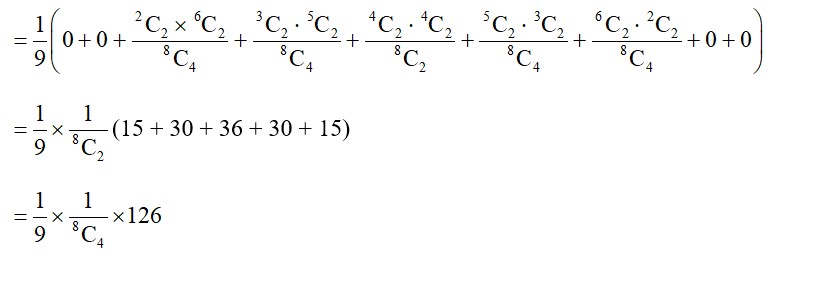
P (2W and 2B) = P (2B, 6W) × P (2W and 2B)
+ P (3B, 5W) × P (2W and 2B)
+ P (4B, 4W) × P (2W and 2B)
+ P (5B, 3W) × P (2W and 2B)
+ P (6B, 2W) × P (2W and 2B)
(15 + 30 + 36 + 30 + 15)
Let probability of tail is
⇒ Probability of getting head =
∴ Probability of getting 2 heads and 1 tail
ax2 + bx + c = 0
D = b2 – 4ac
D = 0
b2 – 4ac = 0
b2 = 4ac
(i) AC = 1, b = 2 (1, 2, 1) is one way
(ii) AC = 4, b = 4
(iii) AC = 9, b = 6, a = 3, c = 3 is one way
1 + 3 + 1 = 5 way
Required probability =
Taking an Exam? Selecting a College?
Get authentic answers from experts, students and alumni that you won't find anywhere else.
On Shiksha, get access to
Learn more about...

Didn't find the answer you were looking for?
Search from Shiksha's 1 lakh+ Topics
Ask Current Students, Alumni & our Experts
Have a question related to your career & education?
See what others like you are asking & answering