
9. A balloon, which always remains spherical has a variable radius. Find the rate at which its volume is increasing with the radius when the later is 10 cm
9. A balloon, which always remains spherical has a variable radius. Find the rate at which its volume is increasing with the radius when the later is 10 cm
The volume v of a spherical balloon with radius r is V.
with respect its radius.
Then, the rate of change of volume
= 4 r2
Whenx = 10 cm,
= 4 10)2 = 400 cm3/cm
 Upvote
Similar Questions for you
y (x) = ∫? (2t² - 15t + 10)dt
dy/dx = 2x² - 15x + 10.
For tangent at (a, b), slope is m = dx/dy = 1 / (dy/dx) = 1 / (2a² - 15a + 10).
Given slope is -1/3.
2a² - 15a + 10 = -3
2a² - 15a + 13 = 0 (The provided solution has 2a²-15a+7=0, suggesting a different problem or a typo)
Following the image: 2a² - 15a
f' (c) = 1 + lnc = e/ (e-1)
lnc = e/ (e-1) - 1 = (e - (e-1)/ (e-1) = 1/ (e-1)
c = e^ (1/ (e-1)
Area
3x2 = 10
x = k
3k2 = 10
By truth table
So F1 (A, B, C) is not a tautology
Now again by truth table
So F2 (A, B) be a tautology.
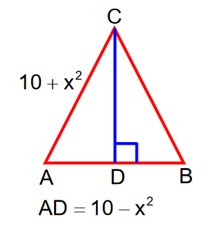
From option let it be isosceles where AB = AC then
=
Now ar
then
So .
Hence be equilateral having each side of length
Taking an Exam? Selecting a College?
Get authentic answers from experts, students and alumni that you won't find anywhere else.
On Shiksha, get access to
Learn more about...

Maths Ncert Solutions class 12th 2026
View Exam DetailsMost viewed information
SummaryDidn't find the answer you were looking for?
Search from Shiksha's 1 lakh+ Topics
Ask Current Students, Alumni & our Experts
Have a question related to your career & education?
See what others like you are asking & answering