
Four dice are thrown simultaneously and the numbers shown on these dice are recorded in 2 * 2 matrices. The probability that such formed matrices have all different entries and are non-singular, is:
Four dice are thrown simultaneously and the numbers shown on these dice are recorded in 2 * 2 matrices. The probability that such formed matrices have all different entries and are non-singular, is:
All entries different which can be selected as 

Let be such matrix
|A| = ad – bc
Now | A| = 0 -> ad – bc = 0 cases
1, 6 3, 2 2 * 2 * 2
2, 6 3, 4
 Upvote
Similar Questions for you
P (2 obtained on even numbered toss) = k (let)
P (2) =
P (
If x = 0, y = 6, 7, 8, 9, 10
If x = 1, y = 7, 8, 9, 10
If x = 2, y = 8, 9, 10
If x = 3, y = 9, 10
If x = 4, y = 10
If x = 5, y = no possible value
Total possible ways = (5 + 4 + 3 + 2 + 1) * 2
= 30
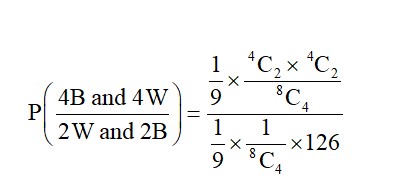
Required probability
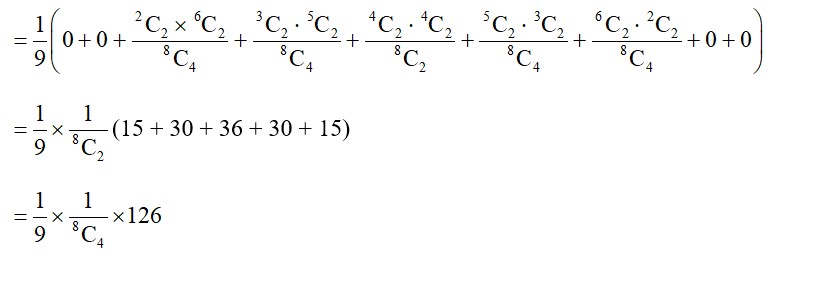
P (2W and 2B) = P (2B, 6W) × P (2W and 2B)
+ P (3B, 5W) × P (2W and 2B)
+ P (4B, 4W) × P (2W and 2B)
+ P (5B, 3W) × P (2W and 2B)
+ P (6B, 2W) × P (2W and 2B)
(15 + 30 + 36 + 30 + 15)
Let probability of tail is
⇒ Probability of getting head =
∴ Probability of getting 2 heads and 1 tail
ax2 + bx + c = 0
D = b2 – 4ac
D = 0
b2 – 4ac = 0
b2 = 4ac
(i) AC = 1, b = 2 (1, 2, 1) is one way
(ii) AC = 4, b = 4
(iii) AC = 9, b = 6, a = 3, c = 3 is one way
1 + 3 + 1 = 5 way
Required probability =
Taking an Exam? Selecting a College?
Get authentic answers from experts, students and alumni that you won't find anywhere else.
On Shiksha, get access to
Learn more about...

Chemistry NCERT Exemplar Solutions Class 12th Chapter Five 2025
View Exam DetailsMost viewed information
SummaryDidn't find the answer you were looking for?
Search from Shiksha's 1 lakh+ Topics
Ask Current Students, Alumni & our Experts
Have a question related to your career & education?
See what others like you are asking & answering