Let f be a differentiable function in (0,π12) If cosx1t2f(t)dt=sin3x+cosx, then 13f'(13) is equal to...........

Option 1 - <p><span class="mathml" contenteditable="false"> <math> <mrow> <mn>6</mn> <mo>−</mo> <mn>9</mn> <mroot> <mrow> <mn>2</mn> </mrow> <mrow></mrow> </mroot> </mrow> </math> </span></p>
Option 2 - <p><span class="mathml" contenteditable="false"> <math> <mrow> <mn>6</mn> <mo>−</mo> <mfrac> <mrow> <mn>9</mn> </mrow> <mrow> <mroot> <mrow> <mn>2</mn> </mrow> <mrow></mrow> </mroot> </mrow> </mfrac> </mrow> </math> </span></p>
Option 3 - <p><span class="mathml" contenteditable="false"> <math> <mrow> <mfrac> <mrow> <mn>9</mn> </mrow> <mrow> <mn>2</mn> </mrow> </mfrac> <mo>−</mo> <mn>6</mn> <mroot> <mrow> <mn>2</mn> </mrow> <mrow></mrow> </mroot> </mrow> </math> </span></p>
Option 4 - <p><span class="mathml" contenteditable="false"> <math> <mrow> <mfrac> <mrow> <mn>9</mn> </mrow> <mrow> <mroot> <mrow> <mn>2</mn> </mrow> <mrow></mrow> </mroot> </mrow> </mfrac> <mo>−</mo> <mn>6</mn> </mrow> </math> </span></p>
3 Views|Posted 8 months ago
Asked by Shiksha User
1 Answer
P
8 months ago
Correct Option - 2
Detailed Solution:

cosx1t2f (t)dt=sin3x+cosx

sinxcos2xf (cosx)=3sin2xcosxsinx

f' (cosx) (sinx)=3sec2x2sec2tanx

cosx=13

f' (13) (23)=962

13f' (13)=69

Thumbs Up IconUpvote Thumbs Down Icon

Similar Questions for you

y (x) = ∫? (2t² - 15t + 10)dt
dy/dx = 2x² - 15x + 10.
For tangent at (a, b), slope is m = dx/dy = 1 / (dy/dx) = 1 / (2a² - 15a + 10).
Given slope is -1/3.
2a² - 15a + 10 = -3
2a² - 15a + 13 = 0 (The provided solution has 2a²-15a+7=0, suggesting a different problem or a typo)
Following the image: 2a² - 15a

...Read more

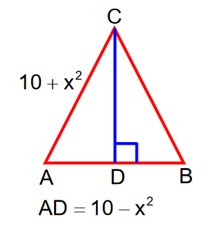
C D = ( 1 0 + x 2 ) 2 ( 1 0 x 2 ) 2 = 2 1 0 | x |

Area 

= 1 2 × C D × A B = 1 2 × 2 1 0 | x | ( 2 0 2 x 2 )

1 0 x 2 = 2 x

3x2 = 10

 x = k

3k2 = 10

From option let it be isosceles where AB = AC then

x = r 2 ( h r ) 2            

r 2 h 2 r 2 + 2 r h

x = 2 h r h 2 . . . . . . . . ( i )

 Now ar ( Δ A B C ) = Δ = 1 2 B C × A L

Δ = 1 2 × 2 2 h r a 2 × h        

then  x = 2 × 3 r 2 × r 9 r 2 4 = 3 2 r f r o m ( i )

B C = 3 r    

So A B = h 2 + x 2 = 9 r 2 4 + 3 r 2 4 = 3 r .

Hence Δ be equilateral having each side of length 3 r .

...Read more

Taking an Exam? Selecting a College?

Get authentic answers from experts, students and alumni that you won't find anywhere else.

On Shiksha, get access to

66K
Colleges
|
1.2K
Exams
|
6.9L
Reviews
|
1.8M
Answers

Learn more about...

Maths NCERT Exemplar Solutions Class 12th Chapter Eight 2025

Maths NCERT Exemplar Solutions Class 12th Chapter Eight 2025

View Exam Details

Most viewed information

Summary

Share Your College Life Experience

Didn't find the answer you were looking for?

Search from Shiksha's 1 lakh+ Topics

or

Ask Current Students, Alumni & our Experts

Have a question related to your career & education?

or

See what others like you are asking & answering