
A circular coil has moment of inertia 0.8 kg m² around any diameter and is carrying current to produce a magnetic moment of 20Am². The coil is kept initially in a vertical position and it can rotate freely around a horizontal diameter. When a uniform magnetic field of 4 T is applied along the vertical, it starts rotating around its horizontal diameter. The angular speed the coil acquires after rotating by 60° will be:
A circular coil has moment of inertia 0.8 kg m² around any diameter and is carrying current to produce a magnetic moment of 20Am². The coil is kept initially in a vertical position and it can rotate freely around a horizontal diameter. When a uniform magnetic field of 4 T is applied along the vertical, it starts rotating around its horizontal diameter. The angular speed the coil acquires after rotating by 60° will be:
I = 0.8 kgM², |μ? | = 20Am²
U? = -μ? ⋅ B? = 0
Uf = -μBcos (30°) = -20 x 4 x √3/2
U? – Uf = 40√3 = ½ I ω² = 0.4ω²
ω² = 100√3; ω = 10 (3¹/? )
 Upvote
Similar Questions for you

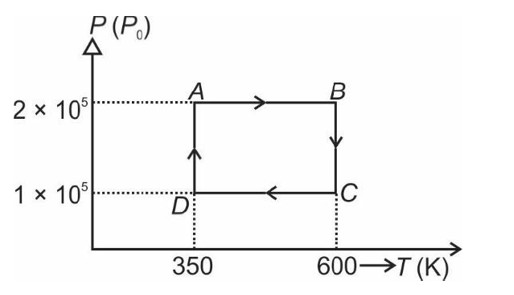
From A to B the process is isobaric
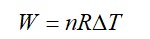
= W = 2 × R (600 - 350)
= 500 R
Taking an Exam? Selecting a College?
Get authentic answers from experts, students and alumni that you won't find anywhere else.
On Shiksha, get access to
Learn more about...

Physics System of Particles and Rotational Motion 2025
View Exam DetailsMost viewed information
SummaryDidn't find the answer you were looking for?
Search from Shiksha's 1 lakh+ Topics
Ask Current Students, Alumni & our Experts
Have a question related to your career & education?
See what others like you are asking & answering