
A parallel plate capacitor whose capacitance C is 14 pF is charged by a battery to a potential difference V = 12V between its plates. The charging battery is now disconnected and a porcelain plate with k = 7 is inserted between the plates, then the plate would oscillate back and forth between the plates with a constant mechanical energy of .......... pJ. (Assume no friction)
A parallel plate capacitor whose capacitance C is 14 pF is charged by a battery to a potential difference V = 12V between its plates. The charging battery is now disconnected and a porcelain plate with k = 7 is inserted between the plates, then the plate would oscillate back and forth between the plates with a constant mechanical energy of .......... pJ. (Assume no friction)
Initial charge Q = CV = 14 * 10? ¹² * 12 = 168 * 10? ¹² C
Initial energy U_in = ½ CV² = ½ (14 * 10? ¹²) * 12² = 1008 pJ
When the battery is disconnected and a dielectric (k=7) is inserted, the new capacitance is C' = kC.
The charge Q remains constant.
Final energy U_f = Q²/2C' = Q²/ (2kC) = (CV)²/ (2kC)
 Upvote
Similar Questions for you
For force between q1 and q2 is maximum, q1 = q2
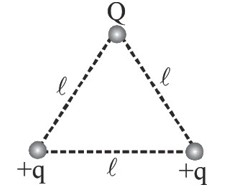
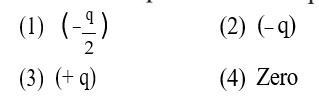
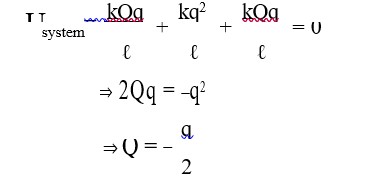
When positive charge moves from low potential to high potential region, work is done against electric field and potential energy increases.
Taking an Exam? Selecting a College?
Get authentic answers from experts, students and alumni that you won't find anywhere else.
On Shiksha, get access to
Learn more about...

Physics Electrostatic Potential and Capacitance 2025
View Exam DetailsMost viewed information
SummaryDidn't find the answer you were looking for?
Search from Shiksha's 1 lakh+ Topics
Ask Current Students, Alumni & our Experts
Have a question related to your career & education?
See what others like you are asking & answering