
A particle of mass M originally at rest is subjected to a force whose direction is constant but magnitude varies with time according to the relation F = F₀[1 - ((t-T)/T)²]
Where F₀ and T are constants. The force acts only for the time interval 2T. The velocity v of the particle after time 2T is:
A particle of mass M originally at rest is subjected to a force whose direction is constant but magnitude varies with time according to the relation F = F₀[1 - ((t-T)/T)²]
Where F₀ and T are constants. The force acts only for the time interval 2T. The velocity v of the particle after time 2T is:
v = ∫a dt = (1/M)∫F dt
v = (F? /M) ∫ [1 - (t-T)²/T²] dt from 0 to 2T
= (F? /M) [t - (t-T)³/3T²]? ²?
= (F? /M) [ (2T - T³/3T²) - (0 - (-T)³/3T²) ]
= (F? /M) [ 2T - T/3 - T/3 ] = (F? /M) [ 4T/3 ] = 4F? T/3M.
 Upvote
Similar Questions for you

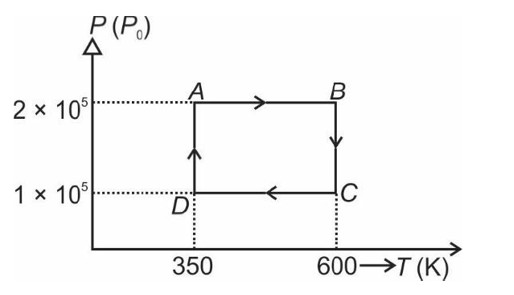
From A to B the process is isobaric
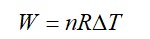
= W = 2 × R (600 - 350)
= 500 R
Taking an Exam? Selecting a College?
Get authentic answers from experts, students and alumni that you won't find anywhere else.
On Shiksha, get access to
Learn more about...

Physics Work, Energy and Power 2021
View Exam DetailsMost viewed information
SummaryDidn't find the answer you were looking for?
Search from Shiksha's 1 lakh+ Topics
Ask Current Students, Alumni & our Experts
Have a question related to your career & education?
See what others like you are asking & answering