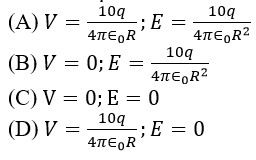
Ten charges are placed on the circumference of a circle of radius with constant angular separation between successive charges. Alternate charges 1, 3, 5, 7, 9 have charge (+q) each, while have charge (-q)each. The potential v and the electric field E at the centre of the circle are respectively: (Take V = 0 at infinity)
Potential of centre, = V =
Vc = K (Σq)/R
Vc = K (0)/R = 0
Electric field at centre E_B = E_B = ΣE
Let E be electric field produced by each
charge at the centre, then resultant electric field will be
Ec = 0, since equal electric field vectors are acting at equal angle so their resultant is equal to zero.
Similar Questions for you
For force between q1 and q2 is maximum, q1 = q2
When positive charge moves from low potential to high potential region, work is done against electric field and potential energy increases.
Taking an Exam? Selecting a College?
Get authentic answers from experts, students and alumni that you won't find anywhere else.
On Shiksha, get access to
Learn more about...

Physics Electrostatic Potential and Capacitance 2025
View Exam DetailsMost viewed information
SummaryDidn't find the answer you were looking for?
Search from Shiksha's 1 lakh+ Topics
Ask Current Students, Alumni & our Experts
Have a question related to your career & education?
See what others like you are asking & answering