
Ask & Answer: India's Largest Education Community

All Questions
New Question
11 months agoContributor-Level 10
Radius of the narrow tube, r = 1 mm= 1 m
Surface tension of mercury at the given temperature, s= 0.465 N/m
Density of mercury kg/
Dipping depth = h
Acceleration due to gravity, g = 9.8 m/
Surface tension related with angle of contact and dipping depth is given by:
s = or h = = = -5.345 m= -5.345 mm
New Question
11 months agoContributor-Level 10
Radius of the uncharged drop, r = 2.0 m
Density of the uncharged drop, = 1.2 kg/
Viscosity of air, = 1.8 Pas
Density of air , can be taken as zero in order to neglect the buoyancy of air
Acceleration due to gravity, g = 9.8 m/
Terminal velocity, v can be written as
v = = = 0.05807 m/s = 5.8 cm/s
The viscous force on the drop is given by
F = 6 = 6 1.8 2.0 0.05807
= 3.9 N
New Question
11 months agoContributor-Level 10
The area of the wing of the plane, A = 2 = 50
Speed of air over the lower wing, = 180 km/h = 50 m/s
Speed of air over the upper wing, = 234 km/h = 65 m/s
Density of air, = 1 kg/
Let us assume, pressure over the lower wing = and pressure over the upper wing =
The upward force on the plane can be obtained using Bernoulli’s equation:
On lower wing= + , On upper wing = +
From equilibrium of momentum
+ = +
( - )
The net upward force = ( - = )
New Question
11 months agoContributor-Level 10
Radius of the artery, r = 2 m
Diameter of the artery, d = 4 m
Viscosity of blood, = 2.084 Pa-s
Density of the blood, = 1.06 kg/
Reynolds’s number for laminar flow, = 2000
The largest velocity is given by the relation: =
= = 0.983 m/s
Flow rate is given by the relation:
R = = 3.1416 = 1.235 /s
New Question
11 months agoContributor-Level 10
Diameter of the artery, d = 2 m
Viscosity of the blood, = 2.084 Pa-s
Density of the blood, = 1.06 kg/
Reynolds’s number for laminar flow, = 2000
= = = 1.966 m/s
As the fluid velocity increases, the dissipative forces become more important. This is because of the rise of turbulence. Turbulent flow causes dissipative loss in a fluid.
New Question
11 months agoContributor-Level 10
Gauge pressure, P = 2000 Pa
Density of whole blood, = 1.06 kg/
Acceleration due to gravity, g = 9.8 m/s
Let the height of the blood container = h
Pressure on the blood container P =
By equating, we get h = (2000)/ ( 1.06 = 0.1925m
New Question
11 months agoContributor-Level 10
Two vessels, having the same base area, will have identical force and equal pressure acting on their common base area. Since the shapes of the two vessels are different, the force exerted on the sides of the vessels has non-zero vertical components.
When these vertical components are added, the total force on one vessel comes out to be more than on the other vessel. Hence, when these vessels are filled with water to the same height, they give different readings on the weighing scale.
New Question
11 months agoNew Question
11 months ago
Contributor-Level 10
Atmospheric pressure, = 76 cm of Hg
For figure (a)
Difference between the levels of mercury in the two limbs gives gauge pressure
Hence, gauge pressure = 20 cm of Hg
Absolute pressure = Atmospheric pressure + Gauge pressure = 76 + 20 = 96 cm of Hg
For figure (b),
Difference between the levels of mercury in the two limbs gives gauge pressure
Hence, gauge pressure = - 18 cm of Hg
Absolute pressure = Atmospheric pressure + Gauge pressure = 76 - 18 = 58 cm of Hg
When 13.6 cm of water is poured into the right limb of figure (b)
Relative density of mercury = 13.6
Hence, a column of 13.6 cm of water is equivalent to 1 cm of Mercury.
Let h be
New Question
11 months agoContributor-Level 10
Base area of the given tank, A = 1.0
Area of the hinged door, a = 20 = 20
Density of water, = kg/
Density of acid, = 1.7 kg/
Height of the water column, = 4 m
Height of the acid column, = 4 m
Acceleration due to gravity, g = 9.8 m/
The pressure due to Water column, = = = 3.92 Pa
The pressure due to Acid column, = = 1.7 = 6.64 Pa
Pressure difference between two columns ΔP = - = 2.774 Pa
Force exerted on the sma
New Question
11 months agoContributor-Level 10
11.22
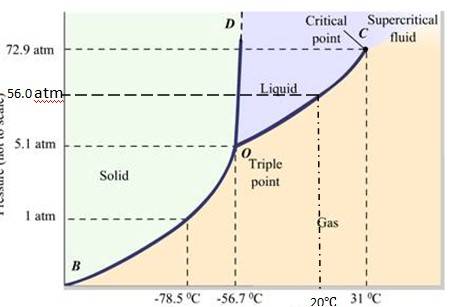
The fusion and boiling points are given by the intersection point where this parallel line cuts the fusion and vaporization curves. It departs from ideal gas behavior as pressure increases.
(a) At 1 atm pressure and at – 60 °C, it lies left of -56.6 (triple point O). Hence, it lies in the region of vapour and solid phases. Thus, CO2 condenses into solid state directly, without going through liquid phases.
(b) At 4 atm pressure, CO2 lies below 5.11 atm (triple point O). Hence it lies in the region of vaporous and solid phases. Thus, CO2 condenses into solid state directly, without going through liquid
New Question
11 months agoContributor-Level 10
Soap bubble radius, r = 5.0 mm = 5 m
Surface tension of the soap bubble, S = 2.50 N/m
Relative density of soap solution = 1.20, hence density of soap solution, = 1.2 Kg/
Air bubble formed at a depth, h = 40 cm = 0.4 m
1 atmospheric pressure = 1.01 Pa
Acceleration due to gravity, g = 9.8 m/
We know, the excess pressure inside the soap bubble is given by the relation:
P = = Pa = 20 Pa
Hence, the excess pressure inside the air bubble is given by the relation, P' = = 10 Pa
At a depth of h, the total pressure inside the air bubble = Atmospheric press
New Question
11 months agoContributor-Level 10
Radius of the mercury droplet, r = 3.00 mm = 3 m
Surface tension, S = 4.65 N/m
Atmospheric pressure, = 1.01 Pa
Total pressure inside the mercury drop = Excess pressure inside mercury + Atmospheric pressure
= + = + 1.01 = 1.01310 Pa
Excess pressure inside mercury = = = 310 Pa
New Question
11 months agoContributor-Level 10
11.21
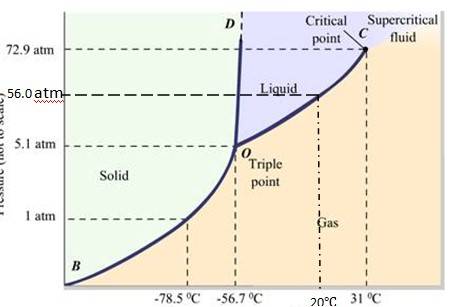
(a) The P-T phase diagram for CO2 is shown here. O is the triple point of the CO2 phase diagram. This means that at the temperature and pressure corresponding to this point, the solid, liquid and vaporous phases of CO2 exists in equilibrium.
(b) The fusion and the boiling points of CO2 decreases with a decrease in pressure.
(c) The critical temperature and critical pressure of CO2 are 31 72.9 atm respectively. Even if it is compressed to a pressure greater than 72.9 atm, CO2 will not liquefy above the critical temperature.
(d) It can be concluded from the P-T phase diagram of CO2 that:
CO2 is gaseous at -70 , under 1 atm pr
New Question
11 months ago
Contributor-Level 10
The length of the liquid film supported by the weight, l = 40 cm = 0.4 m
The weight supported by the film, W = 4.5 N
Since a liquid film has two free surfaces,
Surface tension = = = 5.625 N/m
In all 3 figures, the liquid is the same, temperature is also the same. Hence the surface tension in (b) and (c) are also going to be the same, with the value of 5.625 N/m and weight supported in each case is also going to be the same, since length of the film is same.
New Question
11 months agoContributor-Level 10
The weight that the soap film supports, W = 1.5 N
Length of the slider, l = 30 cm = 0.3 m
A soap film has two free surfaces, hence total length = 2l = 0.6 m
Surface tension, S= = = 2.5 N/m
New Question
11 months agoBeginner-Level 5
Yes, you can pursue Computer Science Engineering (CSE) with a specialisation at Sastra University. The university offers various branches and specializations within the CSE department, which might include areas like Data Science, Artificial Intelligence, Cybersecurity, Software Engineering, and others, depending on the course offerings at the time.
To get CSE, you would typically need to meet the eligibility requirements, including:
Academic Qualifications: A minimum of 50% (or as per the current criteria) in your higher secondary education with Physics, Chemistry, and Mathematics as core subjects.
Entrance Exams: The university conducts
New Question
11 months agoContributor-Level 10
Area of cross-section of the spray pump, = 8 = 8
Number of holes, n = 40
Diameter of each hole, d = 1 mm = 1 m
Radius of each hole, r = d/2 = 0.5 m
Area of cross-section of each hole, a = =
Total area of 40 holes, = 40 = 3.14
Speed of liquid inside the tube, = 1.5 m/min = 0.025 m/s
Speed of ejection of liquid =
According to law of continuity, we have = or =
= 0.637 m/s
New Question
11 months ago
Contributor-Level 10
Take the case given in figure (b)

= Area of pipe 1, = Area of pipe 2, = Speed of fluid in pipe 1, = Speed of fluid in pipe 2
From the law of continuity, we have
=
When the area of cross-section in the middle of the venturimeter is small, the speed of the flow of liquid through this part is more. According to Bernoulli's principle, if speed is more, the pressure is less. Pressure is directly proportional to height, hence the level of water in pipe 2 is less. Therefore, figure (a) is not possible.
New Question
11 months agoContributor-Level 10
Christ Bannerghatta campus provides good placement opportunities to its MBA graduating students. Check out the table below to know the key highlights of the Christ Bannerghatta campus placements 2025:
Particulars | Placement Statistics (2025) |
|---|---|
the highest Package | INR 15.75 LPA |
Total Offers | 268 (MBA/PGDM) |
Top Recruiters | EY GDS, Deloitte, Zomato, etc. |
Top Sector | Audit Assistant (20%) |
Register to get relevant
Questions & Discussions on your feed
Ask & Answer
Panel of Experts