
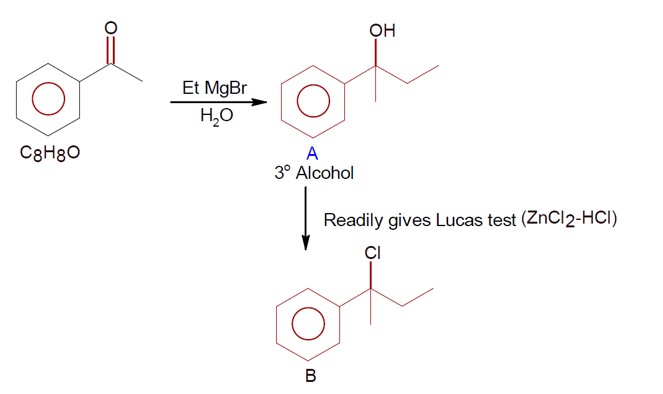
Reaction of Grignard reagent, C?H?MgBr with C?H?O followed by hydrolysis gives compound "A” which reacts instantly with Lucas reagent to give compound B, C??H??Cl. The compound B is:
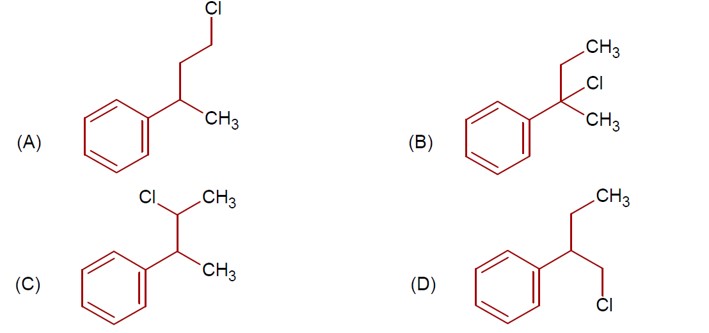
Reaction of Grignard reagent, C?H?MgBr with C?H?O followed by hydrolysis gives compound "A” which reacts instantly with Lucas reagent to give compound B, C??H??Cl. The compound B is:
Please consider the following Image
 Upvote
Similar Questions for you
ATP has phosphate group, PO? ³?
So x + 4 (– 2) = – 3 or x = + 5
2 Pb (NO? )? → 2PbO + 2NO? + O?
2NO? → N? O? colourless
N? O? + 2NO → 2 N? O?
Oxidation state in N? O? is +3
CrO? ²? (Cr? ) → Cr? ³, Total oxidation number change = 3
MnO? (Mn? ) → Mn? ², Total oxidation number change = 5
Cr? O? ²? (Cr? ) → 2Cr? ³, Total oxidation number change = 6
C? O? ²? (C? ³) → 2CO? (C? ), Total oxidation number change = 2
Taking an Exam? Selecting a College?
Get authentic answers from experts, students and alumni that you won't find anywhere else.
On Shiksha, get access to
Learn more about...

Chemistry Redox Reactions 2025
View Exam DetailsMost viewed information
SummaryDidn't find the answer you were looking for?
Search from Shiksha's 1 lakh+ Topics
Ask Current Students, Alumni & our Experts
Have a question related to your career & education?
See what others like you are asking & answering