
A block of mass 1 kg is pushed up a surface inclined to horizontal at an angle of 30° by a force of 10 N parallel to the inclined surface in fig
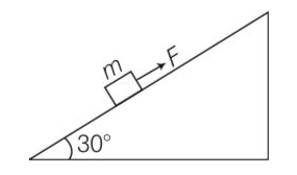
The coefficient of friction between block and the incline is 0.1. If the block is pushed up by 10 m along the incline, calculate
(a) work done against gravity
(b) work done against force of friction
(c) increase in potential energy
(d) increase in kinetic energy
(e) work done by applied force.
A block of mass 1 kg is pushed up a surface inclined to horizontal at an angle of 30° by a force of 10 N parallel to the inclined surface in fig
The coefficient of friction between block and the incline is 0.1. If the block is pushed up by 10 m along the incline, calculate
(a) work done against gravity
(b) work done against force of friction
(c) increase in potential energy
(d) increase in kinetic energy
(e) work done by applied force.
This is a long answer type question as classified in NCERT Exemplar
(a) work done= increase in PE

= mg (vertical distance travelled)
= mg (s)sin = 50J
(b) work done against friction = fs
=
= 0.1
(c) increase in PE =mgh
=1
(d) according to work energy theorem W= change in KE
= -mgh-fs+FS
= -50-8.6
 Upvote
Similar Questions for you
Using Newton’s formula,

This is a multiple choice answer as classified in NCERT Exemplar
This is a multiple choice answer as classified in NCERT Exemplar
(b) conserving energy between “O” ans ”A”

Ui + Ki = Uf + Kf
0+1/2mv2= mgh + 1/2mv’
(v’)2=v2-2gh = v’= ……….1
Let speed after emerging be v1 then
=1/2mv12=1/2[1/2mv’2]
1/2m(v1)2=1/4m(v’)2=1/4m[v2-2gh]
V1= ………….2
From eqn 1 and 2
So v1 = v’/
This is a multiple choice answer as classified in NCERT Exemplar
(b, d) When a man of mass m climbs up the staircases of height L, work done by the gravitational force on the man is mgl work done by internal muscular forces will be mgL as the change in kinetic is almost zero.
Hence total work done =-
This is a multiple choice answer as classified in NCERT Exemplar
(c) m =150g =3/20kg
Time of contact =0.001s
U=126km/h=
V= -35m/s
Change in momentum of the ball = m (v-u)=
=21/2
F= dp/dt=- = - 1.05
Here – negative sign indicates that force will be opposite to the direction of movement of the ball be
Taking an Exam? Selecting a College?
Get authentic answers from experts, students and alumni that you won't find anywhere else.
On Shiksha, get access to
Learn more about...

Physics NCERT Exemplar Solutions Class 11th Chapter Six 2025
View Exam DetailsMost viewed information
SummaryDidn't find the answer you were looking for?
Search from Shiksha's 1 lakh+ Topics
Ask Current Students, Alumni & our Experts
Have a question related to your career & education?
See what others like you are asking & answering