
A block of mass m slides on the wooden wedge, which in turn slides backward on the horizontal surface. The acceleration of the block with respect to the wedge is: Given m = 8 kg, M = 16kg. Assume all the surfaces shown in the figure to be frictionless.
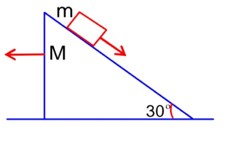
A block of mass m slides on the wooden wedge, which in turn slides backward on the horizontal surface. The acceleration of the block with respect to the wedge is: Given m = 8 kg, M = 16kg. Assume all the surfaces shown in the figure to be frictionless.
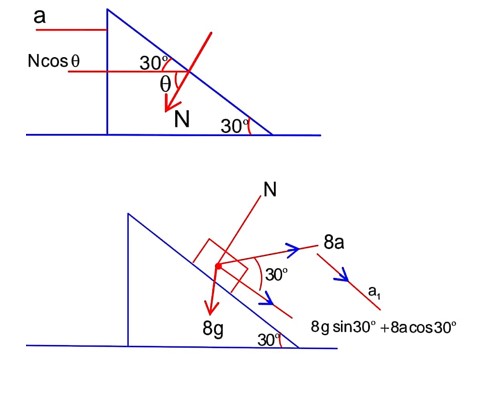
Suppose acceleration of wedge is a and acceleration of block w. r.t. wedge is a1 then N cos60° = Ma = 16 a -> N = 32 a
For block w.r.t. wedge
N + 8a sin 30° = 8g cos 30°
N = 8g cos 30° - 8a sin 30°
->32a = 8g cos 30° - 8a sin 30°
->a =
Now for 8 kg,
 Upvote
Similar Questions for you

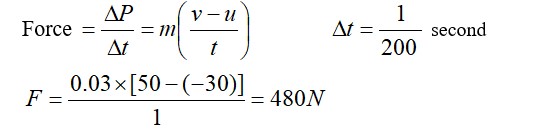

= 0.92 * 1260 = 1161 m/s
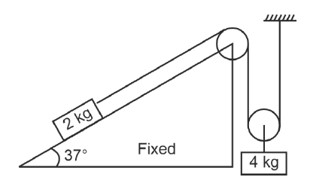
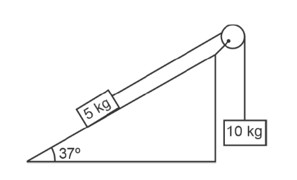
For 2 kg block
T – 2g sin37 = 2a . (i)
For 4 kg block
4g – 2T =
2g – T = a . (ii)
T = (2g – a)
2g – a – 2g × = 2a
3a = 2g ×
Taking an Exam? Selecting a College?
Get authentic answers from experts, students and alumni that you won't find anywhere else.
On Shiksha, get access to
Learn more about...

Didn't find the answer you were looking for?
Search from Shiksha's 1 lakh+ Topics
Ask Current Students, Alumni & our Experts
Have a question related to your career & education?
See what others like you are asking & answering