
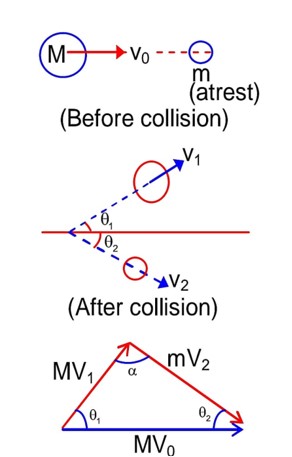
A body of mass M moving at speed V0 collides elastically with a mass 'm' at rest. After the collision, the two masses move at angles q1 and q2 with respect to the initial direction of motion of the body of mass M. The largest possible value of the ratio M/m, for which the angles q1 and q2 will be equal, is:
A body of mass M moving at speed V0 collides elastically with a mass 'm' at rest. After the collision, the two masses move at angles q1 and q2 with respect to the initial direction of motion of the body of mass M. The largest possible value of the ratio M/m, for which the angles q1 and q2 will be equal, is:
Option 1 - <p>3</p>
Option 2 - <p>1</p>
Option 3 - <p>2</p>
Option 4 - <p>4</p>
25 Views|Posted a year ago
Asked by Shiksha User
2 Answers
R
Answered by
a year ago
Correct Option - 1
Detailed Solution:
. (ii)
. (iii)
 Upvote
Similar Questions for you
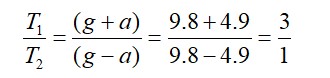
T1 = m (g + a)
T2 = m (g - a)
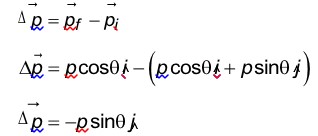
Apparent weight = mg – ma
Taking an Exam? Selecting a College?
Get authentic answers from experts, students and alumni that you won't find anywhere else.
On Shiksha, get access to
67K
Colleges
|
1.2K
Exams
|
7.2L
Reviews
|
1.9M
Answers
Learn more about...

Didn't find the answer you were looking for?
Search from Shiksha's 1 lakh+ Topics
or
Ask Current Students, Alumni & our Experts
Have a question related to your career & education?
or
See what others like you are asking & answering