A boy reaches the airport and find that the escalator is not working. He walks up the stationary escalator in time t1. If he remains stationary on a moving escalator then the escalator takes him up in time t2. The time taken by him to walk up on the moving escalator will be:

Option 1 - <p><span class="mathml" contenteditable="false"> <math> <mrow> <mfrac> <mrow> <msub> <mrow> <mi>t</mi> </mrow> <mrow> <mn>1</mn> </mrow> </msub> <msub> <mrow> <mi>t</mi> </mrow> <mrow> <mn>2</mn> </mrow> </msub> </mrow> <mrow> <msub> <mrow> <mi>t</mi> </mrow> <mrow> <mn>2</mn> </mrow> </msub> <mo>+</mo> <msub> <mrow> <mi>t</mi> </mrow> <mrow> <mn>1</mn> </mrow> </msub> </mrow> </mfrac> </mrow> </math> </span></p>
Option 2 - <p><span class="mathml" contenteditable="false"> <math> <mrow> <msub> <mrow> <mi>t</mi> </mrow> <mrow> <mn>2</mn> </mrow> </msub> <mo>−</mo> <msub> <mrow> <mi>t</mi> </mrow> <mrow> <mn>1</mn> </mrow> </msub> </mrow> </math> </span></p>
Option 3 - <p><span class="mathml" contenteditable="false"> <math> <mrow> <mfrac> <mrow> <msub> <mrow> <mi>t</mi> </mrow> <mrow> <mn>1</mn> </mrow> </msub> <mo>+</mo> <msub> <mrow> <mi>t</mi> </mrow> <mrow> <mn>2</mn> </mrow> </msub> </mrow> <mrow> <mn>2</mn> </mrow> </mfrac> </mrow> </math> </span></p>
Option 4 - <p><span class="mathml" contenteditable="false"> <math> <mrow> <mfrac> <mrow> <msub> <mrow> <mi>t</mi> </mrow> <mrow> <mn>1</mn> </mrow> </msub> <msub> <mrow> <mi>t</mi> </mrow> <mrow> <mn>2</mn> </mrow> </msub> </mrow> <mrow> <msub> <mrow> <mi>t</mi> </mrow> <mrow> <mn>2</mn> </mrow> </msub> <mo>−</mo> <msub> <mrow> <mi>t</mi> </mrow> <mrow> <mn>1</mn> </mrow> </msub> </mrow> </mfrac> </mrow> </math> </span></p>
3 Views|Posted 6 months ago
Asked by Shiksha User
1 Answer
V
6 months ago
Correct Option - 1
Detailed Solution:

Let the distance travelled is x, so

| v E g | = x t 2 speed of escalator for ground

| v B E | = x t 1 speed of boy concerning the escalator

| v B g | = x t 1 + x t 2 speed of boy concerning ground

The time taken by him to walk up the moving escalator = t =  x | v B g |

t = x x t 1 + x t 2 = t 1 t 2 t 1 + t 2

Thumbs Up IconUpvote Thumbs Down Icon

Similar Questions for you

According to question, we can write

 10 = 1 2 a t 2 . . . . . . . . . . . . . . . ( 1 ) a n d                        
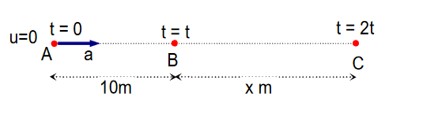
1 0 + x = 1 2 a ( 2 t ) 2 . . . . . . . . . . . . . . . . ( 2 )  

X = 1 2 A [ ( 2 t ) 2 t 2 ] = 3 ( 1 2 a t 2 ) = 3 0 m  


Average speed = 4 v 2 3 v

= 4 v 3

(d) Initial velocity  = - v j ˆ

Final velocity = v i ˆ

Change in velocity  = v i ˆ - ( - v j ˆ )

= v ( i ˆ + j ˆ ) Momentum gain is along i ˆ + j ˆ

 Force experienced is along i ˆ + j ˆ

  Force experienced is in North-East direction.

Taking an Exam? Selecting a College?

Get authentic answers from experts, students and alumni that you won't find anywhere else.

On Shiksha, get access to

66K
Colleges
|
1.2K
Exams
|
6.9L
Reviews
|
1.8M
Answers

Learn more about...

Physics Motion in Straight Line 2025

Physics Motion in Straight Line 2025

View Exam Details

Most viewed information

Summary

Share Your College Life Experience

Didn't find the answer you were looking for?

Search from Shiksha's 1 lakh+ Topics

or

Ask Current Students, Alumni & our Experts

Have a question related to your career & education?

or

See what others like you are asking & answering