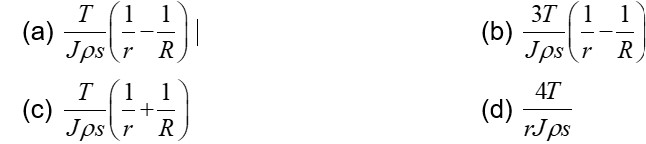
A large number of water drops, each of radius r, combine to have a drop of radius R. If the surface tension is T and mechanical equivalent of heat is J, the rise in heat energy per unit volume will be

Option 1 - <p><span class="mathml" contenteditable="false"> <math> <mrow> <mfrac> <mrow> <mn>3</mn> <mi>T</mi> </mrow> <mrow> <mi>J</mi> </mrow> </mfrac> <mrow> <mo>(</mo> <mrow> <mfrac> <mrow> <mn>1</mn> </mrow> <mrow> <mi>r</mi> </mrow> </mfrac> <mo>−</mo> <mfrac> <mrow> <mn>1</mn> </mrow> <mrow> <mi>R</mi> </mrow> </mfrac> </mrow> <mo>)</mo> </mrow> </mrow> </math> </span></p>
Option 2 - <p><span class="mathml" contenteditable="false"> <math> <mrow> <mfrac> <mrow> <mn>2</mn> <mi>T</mi> </mrow> <mrow> <mi>r</mi> <mi>J</mi> </mrow> </mfrac> </mrow> </math> </span></p>
Option 3 - <p><span class="mathml" contenteditable="false"> <math> <mrow> <mfrac> <mrow> <mn>3</mn> <mi>T</mi> </mrow> <mrow> <mi>r</mi> <mi>J</mi> </mrow> </mfrac> </mrow> </math> </span></p>
Option 4 - <p><span class="mathml" contenteditable="false"> <math> <mrow> <mfrac> <mrow> <mn>2</mn> <mi>T</mi> </mrow> <mrow> <mi>J</mi> </mrow> </mfrac> <mrow> <mo>(</mo> <mrow> <mfrac> <mrow> <mn>1</mn> </mrow> <mrow> <mi>r</mi> </mrow> </mfrac> <mo>−</mo> <mfrac> <mrow> <mn>1</mn> </mrow> <mrow> <mi>R</mi> </mrow> </mfrac> </mrow> <mo>)</mo> </mrow> </mrow> </math> </span></p>
2 Views|Posted 6 months ago
Asked by Shiksha User
1 Answer
P
6 months ago
Correct Option - 1
Detailed Solution:

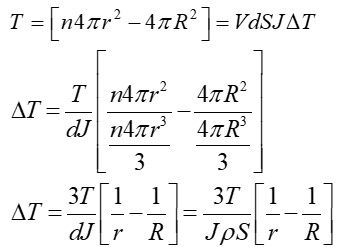
From volume conservation

n*43πr3=43πR3R3=nr3.........(1)

Decrease in surface area = n*4πr24πR2

(ΔA)=4π[nr2R2]=4π[n*r3rR2]=4π[R3rR2]=4πR3[1r1R]

Energy released (W) = T*ΔA=4πR3T[1r1R]

Heat produced (Q) = WJ=4πTR3J[1r1R]

Now,Q=msΔθ

4πR3TJ[1r1R]=(43πR3)*|x|*Δθ=3TJ[1r1R]

Thumbs Up IconUpvote Thumbs Down Icon

Similar Questions for you

Gain in surface energy, Δ U = T Δ A  

from volume centenary,   4 3 π R 3 = 6 4 × 4 3 π r 3  

r = R 4  

Initial surface area, Ai = 4pR2

final surface area,   A f = 6 4 × 4 π r 2  

  Δ U = 1 2 π R 2 . T = 0 . 0 7 5 × 1 2 × 3 . 1 4 × 1 0 4 = 2 . 8 × 1 0 4 J  

Taking an Exam? Selecting a College?

Get authentic answers from experts, students and alumni that you won't find anywhere else.

On Shiksha, get access to

66K
Colleges
|
1.2K
Exams
|
6.9L
Reviews
|
1.8M
Answers

Learn more about...

Physics Mechanical Properties of Fluids 2025

Physics Mechanical Properties of Fluids 2025

View Exam Details

Most viewed information

Summary

Share Your College Life Experience

Didn't find the answer you were looking for?

Search from Shiksha's 1 lakh+ Topics

or

Ask Current Students, Alumni & our Experts

Have a question related to your career & education?

or

See what others like you are asking & answering