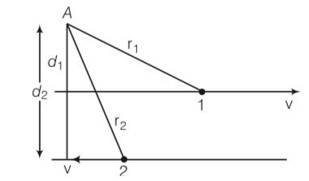
Figure shows two identical particles 1 and 2, each of mass m, moving in opposite directions with same speed v along parallel lines. At a particular instant, r1 and r2 are their respective position vectors drawn from point A which is in the plane of the parallel lines.

Choose the correct options:

(a) Angular momentum l1 of particle 1 about A is I = mvd1 

(b) Angular momentum l2 of particle 2 about A is l2= mvr2

(c) Total angular momentum of the system about A is l= mv(r1+r2)

(d) Total angular momentum of the system about A is l = mv(d2-d1)⊗ represents a unit vector coming out of the page. ⊗ represents a unit vector going into the page.

6 Views|Posted 8 months ago
Asked by Shiksha User
1 Answer
P
8 months ago

This is a multiple choice type question as classified in NCERT Exemplar

(a), (b)As we know L= r * p where r is position vector and p is the linear momentum . the direction of L is perpendicular to both r and p by right hand rule.

For particle 1

I1=r1 * mv is out of the plane of the paper and perpendicu

...Read more

Thumbs Up IconUpvote Thumbs Down Icon

Similar Questions for you

Case – I : When disk slides down

t 1 = 2 L g s i n θ . . . . . . . . . . ( i )              

Case – II : When disk rolls down

t 2 = 2 L g s i n θ 1 + β 2 = 2 L g s i n θ 1 + ( k R ) 2 = 2 L g s i n θ 1 + ( R / 2 R ) 2 = 2 L g s i n θ 1 + 1 2 = 4 L 3 g s i n θ . . . . . . ( i i )             

t 1 t 2 = 2 L g s i n θ × 3 g s i n θ 4 L = 3 2              

...Read more

This is a multiple choice type question as classified in NCERT Exemplar

a, b, d

a) according to the perpendicular axes theorem statement 1 is wrong

b) As z’|z so distance between them = a 2 2 = a 2

So according to parallel axes theorem Iz’=Iz+m (a/ 2 )2= Iz+ma2/2

Hence b is true

c) z’ is not parallel to z hence Pa

...Read more

This is a multiple choice type question as classified in NCERT Exemplar

a, b, c, d

As we know torque = r × F = rFsin θ

a) when forces act radially angle =0 hence torque =0

b) when forces are acting on the axis of rotation r=0 torque=0

c) when forces acting parallel to the axis of rotation angle =0 so torq

...Read more

This is a multiple choice type question as classified in NCERT Exemplar

(a), (c) For general rotational motion where axis of rotation is not symmetric . angular momentum L and angular velocity w need not be parallel. For general translational motion momentum p=mv hence p and v are always parallel.

Taking an Exam? Selecting a College?

Get authentic answers from experts, students and alumni that you won't find anywhere else.

On Shiksha, get access to

66K
Colleges
|
1.2K
Exams
|
6.9L
Reviews
|
1.8M
Answers

Learn more about...

Physics NCERT Exemplar Solutions Class 11th Chapter Seven 2025

Physics NCERT Exemplar Solutions Class 11th Chapter Seven 2025
View Exam Details

Most viewed information

Summary

Share Your College Life Experience

Didn't find the answer you were looking for?

Search from Shiksha's 1 lakh+ Topics

or

Ask Current Students, Alumni & our Experts

Have a question related to your career & education?

or

See what others like you are asking & answering