
In the Young's double slit experiment, the distance between the slits varies in time as d(t) = d? + a? sin(ωt); where d?, ω and a? are constants. The difference between the largest fringe width and the smallest fringe width obtained over time is given as :
In the Young's double slit experiment, the distance between the slits varies in time as d(t) = d? + a? sin(ωt); where d?, ω and a? are constants. The difference between the largest fringe width and the smallest fringe width obtained over time is given as :
β = λD / (d? + a? sinωt)
β? - β? = λD/ (d? - a? ) - λD/ (d? + a? )
= λD [ (d? + a? ) - (d? - a? ) / (d? ² - a? ²) ]
= 2λDa? / (d? ² - a? ²)
 Upvote
Similar Questions for you
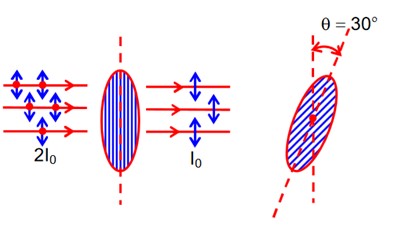
The angle between the plane of vibration and plane of polarization is 90°.
At lower end
Tension, T? = 2g = 20 N (due to the 2 kg block)
Velocity, v? = √ (T? /μ) = √ (20/μ)
Wavelength, λ? = 6 cm
At upper end
Tension, T? = (2 kg + 6 kg)g = 8g = 80 N (due to the block and the rope)
Velocity, v? = √ (T? /μ) = √ (80/μ) = √4 * √ (20/μ) = 2v?
Since frequency (f) remains the same:
f = v?
3d = 0.6mm
D = 80cm
= 800mm
Path difference is given by
BP – Andhra Pradesh = Dx
[for Dark fringe at P]
n = 0, for first dark fringe
first dark fringe is observed on the screen directly opposite to one of the slits]
The distance between two successive bright fringes is fringe width .
Taking an Exam? Selecting a College?
Get authentic answers from experts, students and alumni that you won't find anywhere else.
On Shiksha, get access to
Learn more about...

Physics Ncert Solutions Class 12th 2026
View Exam DetailsMost viewed information
SummaryDidn't find the answer you were looking for?
Search from Shiksha's 1 lakh+ Topics
Ask Current Students, Alumni & our Experts
Have a question related to your career & education?
See what others like you are asking & answering