
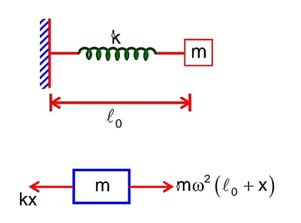
One end of a massless spring of spring constant k and natural length is fixed while the other end is connected to a small object of mass m lying on a frictionless table. The spring remains horizontal on the table. If the object is made to rotate at an angular velocity about an axis passing through fixed end, then the elongation of the spring will be
One end of a massless spring of spring constant k and natural length is fixed while the other end is connected to a small object of mass m lying on a frictionless table. The spring remains horizontal on the table. If the object is made to rotate at an angular velocity about an axis passing through fixed end, then the elongation of the spring will be
F.B.D, with respect to Non-Inertial frame
⇒
 Upvote
Similar Questions for you
Let ‘x’ be the value of one division on main scale
Let ‘y’ be the value of one division on vernier
Now given
50y = 49 x
Let ‘h’ be the height at which velocity becomes equal to magnitude of Acceleration
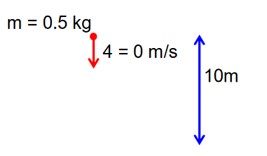
v = g = 10
v = u + at
10 = 0 + 10t
t = 1 sec
= 5m
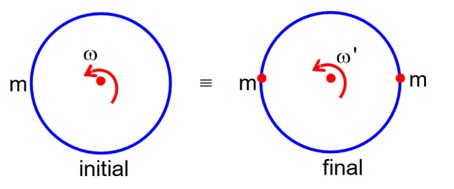
By conservation of Angular momentum
Li = Lf
Taking an Exam? Selecting a College?
Get authentic answers from experts, students and alumni that you won't find anywhere else.
On Shiksha, get access to
Learn more about...

Physics NCERT Exemplar Solutions Class 11th Chapter Eleven 2025
View Exam DetailsMost viewed information
SummaryDidn't find the answer you were looking for?
Search from Shiksha's 1 lakh+ Topics
Ask Current Students, Alumni & our Experts
Have a question related to your career & education?
See what others like you are asking & answering