
Statement I: A cyclist is moving on an un-banked road with a speed of 7 kmh?¹ and takes a sharp circular turn along a path of radius of 2m without reducing the speed. The static friction coefficient is 0.2 The cyclist will not slip and pass the curve. (g = 9.8m/s²)
Statement II: If the road is at an angle of 45°, cyclist can cross of the curve of 2m radius with the speed of 18.5 kmh?¹ without slipping
In the light of the above statements, choose the correct the answer from the options given below.
Statement I: A cyclist is moving on an un-banked road with a speed of 7 kmh?¹ and takes a sharp circular turn along a path of radius of 2m without reducing the speed. The static friction coefficient is 0.2 The cyclist will not slip and pass the curve. (g = 9.8m/s²)
Statement II: If the road is at an angle of 45°, cyclist can cross of the curve of 2m radius with the speed of 18.5 kmh?¹ without slipping
In the light of the above statements, choose the correct the answer from the options given below.
Statement-I: F? = mv²/r ≤ f? = µmg ⇒ v ≤ √ (µgR) = √ (0.2*9.8*2) = 1.98 m/s
v_cyclist = 7 km/h = 1.94 m/s. Since 1.94 m/s < 1.98 m/s, statement-I is correct.
Statement-II: v_max = √gR (tanθ+µ)/ (1-µtanθ) = .
v_min = √gR (tanθ-µ)/ (1+µtanθ) = √ (9.8*2 (tan45-0.2)/ (1+0.2tan45) = 3.65 m/s
v_cyclist = 18.5 km/h = 5.14 m/s. This is outside t
 Upvote
Similar Questions for you


= 0.92 * 1260 = 1161 m/s
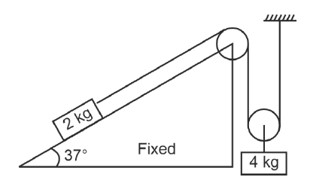
For 2 kg block
T – 2g sin37 = 2a . (i)
For 4 kg block
4g – 2T =
2g – T = a . (ii)
T = (2g – a)
2g – a – 2g × = 2a
3a = 2g ×
Taking an Exam? Selecting a College?
Get authentic answers from experts, students and alumni that you won't find anywhere else.
On Shiksha, get access to
Learn more about...

Didn't find the answer you were looking for?
Search from Shiksha's 1 lakh+ Topics
Ask Current Students, Alumni & our Experts
Have a question related to your career & education?
See what others like you are asking & answering