
Two balls of same mass and carrying equal charge are hung by threads of length from a fixed support. At electrostatic equilibrium, assuming that angles made by each thread is small, the separation, between the balls is proportional to:
Two balls of same mass and carrying equal charge are hung by threads of length from a fixed support. At electrostatic equilibrium, assuming that angles made by each thread is small, the separation, between the balls is proportional to:
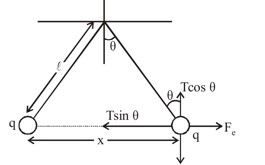
mg In equilibrium,
also
Hence,
Therefore
 Upvote
Similar Questions for you
The medium is affects force. We know this from the constant, k, in Coulomb's Law, that depends on the medium. If you place a charge in an insulator or dielectric medium, like water, the force between them will decrease. This decrease can be taken into account by the medium's permittivity.
The polarity of the charges that are interacting help us understand the direction. Like charges, whether it's both positive or negative, will always repel. Unlike charges, when one is positive and the other is negative, will always attract each other. The force acts along the line connecting the two
The main condition would be that the point charges have to be at rest or be in a stationary position, for Coulomb's Law to work. The thing is, if the charge particles move, we have to consider the impact of magnetic forces then.
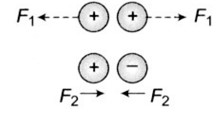
In Case I when both are positively charged, due to induction positive charge moves outwards on spheres, increasing effective distance between centres of charge causing magnitude of the force to decrease.
According to question, we can write
For maxima of force
Taking an Exam? Selecting a College?
Get authentic answers from experts, students and alumni that you won't find anywhere else.
On Shiksha, get access to
Learn more about...

Physics Electric Charge and Field 2025
View Exam DetailsMost viewed information
SummaryDidn't find the answer you were looking for?
Search from Shiksha's 1 lakh+ Topics
Ask Current Students, Alumni & our Experts
Have a question related to your career & education?
See what others like you are asking & answering