
Two bodies and of same mass undergo completely inelastic one dimensional collision. The body moves with velocity while body is at rest before collision. The velocity of the system after collision is . The ratio is
Two bodies and of same mass undergo completely inelastic one dimensional collision. The body moves with velocity while body is at rest before collision. The velocity of the system after collision is . The ratio is
Sol. Before collision 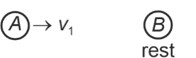
It undergoes completely inelastic collision
Using conservation of linear momentum
Initial momentum = Final momentum
 Upvote
Similar Questions for you
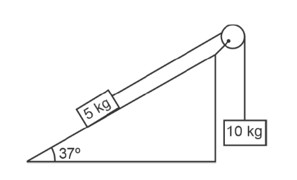
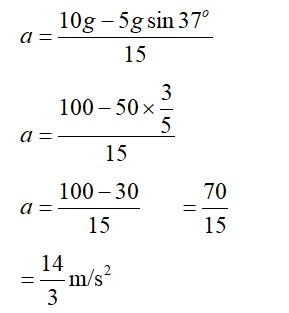

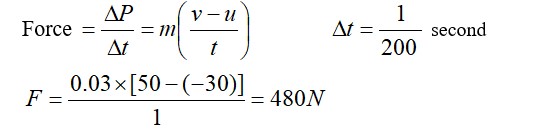

= 0.92 * 1260 = 1161 m/s
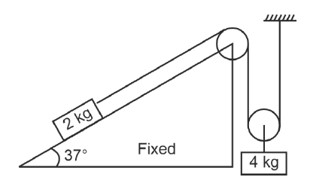
For 2 kg block
T – 2g sin37 = 2a . (i)
For 4 kg block
4g – 2T =
2g – T = a . (ii)
T = (2g – a)
2g – a – 2g × = 2a
3a = 2g ×
Taking an Exam? Selecting a College?
Get authentic answers from experts, students and alumni that you won't find anywhere else.
On Shiksha, get access to
Learn more about...

Didn't find the answer you were looking for?
Search from Shiksha's 1 lakh+ Topics
Ask Current Students, Alumni & our Experts
Have a question related to your career & education?
See what others like you are asking & answering