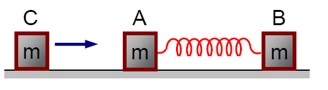
Two identical blocks A and B each of mass m resting on the smooth horizontal floor are connected by a light spring of natural L and spring constant K. A third block C of mass m moving with a speed v along the line joining A and B collides with A. The maximum compression in the spring is:
For an elastic collision where C comes to rest, and the compression in the spring is maximum, the velocities of A and B are equal (v). Using the conservation of mechanical energy:
(1/2)mv? ² = 2 * (1/2)mv² + (1/2)kx²
This gives the maximum compression x as:
x = v? * √* (m / 2k)*
Similar Questions for you
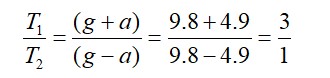
T1 = m (g + a)
T2 = m (g - a)
Apparent weight = mg – ma
Taking an Exam? Selecting a College?
Get authentic answers from experts, students and alumni that you won't find anywhere else.
On Shiksha, get access to
Learn more about...
Didn't find the answer you were looking for?
Search from Shiksha's 1 lakh+ Topics
Ask Current Students, Alumni & our Experts
Have a question related to your career & education?
See what others like you are asking & answering